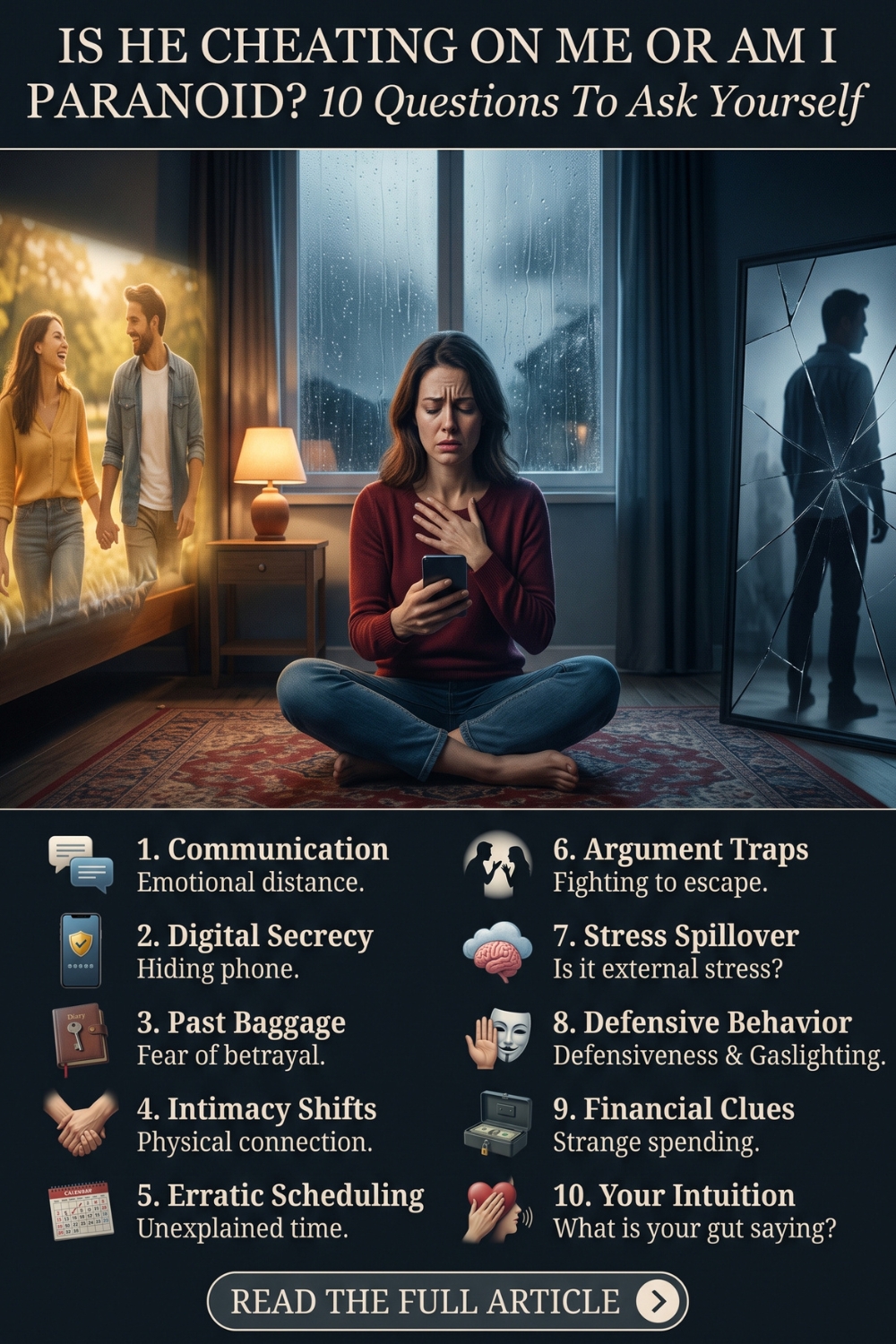

That sinking feeling in the pit of your stomach is one of the most isolating experiences in the world. You notice a slight shift in his routine, a lingering glance at his phone, or an unexplained distance between you two, and suddenly, your mind is racing. The question echoes on a loop: Is he cheating on me or am I paranoid?
When you are deeply invested in a relationship, navigating the murky waters of trust and suspicion is incredibly difficult. You desperately want to achieve your relationship goals and build a lasting bond, but you also refuse to be taken advantage of.
The line between powerful intuition and relationship anxiety can be razor-thin. Sometimes, our past traumas project fears onto a perfectly faithful partner. Other times, our subconscious picks up on subtle behavioral shifts long before our logical brain catches up.
If you are looking for sound relationship advice to help you untangle your thoughts, you are in the right place. In this comprehensive guide, we are going to break down the psychology of suspicion and give you 10 critical questions to ask yourself. These questions are designed to cut through the panic, provide clarity, and offer actionable love tips to help you move forward.
The Psychology of Suspicion: Intuition vs. Paranoia
Before confronting your partner or spiraling into panic, it is essential to understand where your suspicion is coming from. Are you picking up on genuine signs of infidelity, or are you experiencing relationship anxiety?
Why Your Mind Plays Tricks on You
Relationship anxiety often stems from a fear of abandonment or unresolved issues from past partnerships. If you have been betrayed before, your brain goes into hyper-vigilance mode. It actively searches for threats to protect you from future pain. In these moments, innocent behaviors—like your partner staying late at work or changing their phone password for security reasons—can trigger a massive emotional response.
The Power of the Gut Feeling
Conversely, human beings are highly perceptive creatures. We rely heavily on non-verbal communication, micro-expressions, and established baseline behaviors to understand the people around us. When a partner is being deceitful, their baseline behavior shifts. They might become overly defensive, alter their daily routine, or withdraw emotionally. Your “gut feeling” is actually your brain processing hundreds of these tiny, subtle changes and alerting you that something is wrong.
The ultimate piece of relationship advice here is to pause. Do not act on the immediate rush of adrenaline. Instead, take a step back and objectively evaluate the situation using the following ten questions.
10 Questions to Ask Yourself Before Jumping to Conclusions
To figure out if your concerns are rooted in reality or anxiety, you need to look at the complete picture. Ask yourself these ten questions with as much honesty and objectivity as you can muster.
1. Has His Communication Drastically Changed?
Communication is the lifeblood of any healthy partnership. Think about how you two usually interact. Has his texting style completely shifted? If he used to send you long, affectionate messages during his lunch break and now you barely get a one-word reply, that is a noticeable shift.
However, context matters. Is he in the middle of a massive project at work? Is he dealing with a family crisis? If there is no logical external reason for his sudden emotional withdrawal, it might be a red flag. Cheaters often create emotional distance to cope with their own guilt or because their emotional energy is being redirected toward someone else.
2. Is He Suddenly Hyper-Protective of His Phone?
In the modern dating world, the smartphone is the epicenter of infidelity. Pay close attention to his digital habits.
-
Does he take his phone into the bathroom with him every single time?
-
Does he place his phone face-down on the table when you are together?
-
Has he recently changed his passcode and refused to share it with you?
-
Do you notice him hastily closing apps or locking the screen when you walk into the room?
While everyone is entitled to privacy, secrecy is entirely different. A healthy relationship relies on transparency. If his phone has suddenly become a heavily guarded fortress, your suspicions might be justified.
3. Are My Past Relationships Affecting My Current Trust?
This is where you have to hold a mirror up to yourself. Love advice often requires brutal self-honesty. Have you been cheated on before? Did a parent abandon you?
If you carry unhealed trauma into your current relationship, your internal alarm system might be malfunctioning. You might be projecting the sins of an ex-boyfriend onto a partner who has been nothing but loyal. If your current partner has consistently shown up for you, communicated openly, and given you no tangible reason to doubt him, your paranoia might be an internal issue that requires personal healing or therapy.
4. Has Our Physical Intimacy Shifted Unexpectedly?
Changes in the bedroom can be a profound indicator of a relationship’s health. Many people assume that if a man is cheating, he will stop wanting physical intimacy with his partner. While this is often true, the opposite can also occur.
Sometimes, a cheating partner will suddenly initiate intimacy more frequently to overcompensate and alleviate their guilt. They might also introduce entirely new techniques or requests that seem completely out of left field. Again, context is key. A natural ebb and flow in intimacy is normal in long-term relationships, but sudden, unexplained, and drastic changes warrant a closer look.
5. Do His Schedules and Stories Have Unexplainable Gaps?
Cheating requires time, logistics, and planning. Because of this, a deceitful partner’s schedule will often become erratic.
-
Is he suddenly working late several nights a week, but his paycheck doesn’t reflect the overtime?
-
Does he run to the grocery store for a single item and disappear for three hours?
-
When you ask simple questions about his day, do his stories seem overly rehearsed or lack logical sense?
Liars struggle to keep their stories straight. If you notice inconsistencies in his timeline or if he gets highly defensive when you ask casual questions about his day, pay attention.
6. Is He Picking Fights to Create Distance?
One of the most manipulative tactics a cheating partner will use is starting unnecessary arguments. Why? Because picking a fight serves two purposes. First, it gives him an excuse to storm out of the house (and go see someone else). Second, it flips the script, making you the bad guy and easing his own internal guilt.
If he is suddenly hyper-critical of the way you dress, the way you cook, or the way you breathe, he may be intentionally sabotaging the peace in your home to justify his external behavior.
7. Am I Dealing with Outside Stress That’s Spilling Over?
Stress is a powerful emotion that can completely warp our perception of reality. Are you currently dealing with extreme stress at work? Are you facing financial difficulties or health issues?
When we are deeply stressed, our brains are flooded with cortisol, making us irritable, anxious, and prone to worst-case-scenario thinking. Sometimes, the feeling of “something is wrong in my relationship” is actually just “something is wrong in my life, and I am projecting it onto the closest person to me.” Make sure your relationship tips the scale toward fairness by evaluating your own mental state first.
8. How Does He React When I Express My Insecurities?
This is perhaps the most telling question on this list. In a healthy relationship, if you go to your partner and say, “I have been feeling really insecure and disconnected lately,” they will respond with empathy. They will offer reassurance, listen to your concerns, and work with you to rebuild that bridge of trust.
A cheating partner will almost always react with explosive anger, defensiveness, or gaslighting. They will call you “crazy,” accuse you of suffocating them, or turn the accusation around on you. If his immediate reaction to your vulnerability is to attack your sanity, that is a massive red flag.
9. Has His Financial Behavior or Spending Changed?
Affairs are expensive. They require dinners, hotel rooms, gifts, and extra gas. If you share finances or have a good grasp of his spending habits, look for anomalies.
-
Are there unexplained ATM cash withdrawals?
-
Is he suddenly secretive about his credit card statements?
-
Are there strange charges on shared accounts?
Financial infidelity often goes hand-in-hand with physical or emotional infidelity. If the math isn’t mathing, you have a right to ask questions.
10. What Does My Gut Actually Say When I Am Calm?
Anxiety is loud, frantic, and urgent. Intuition is quiet, persistent, and calm.
Take a moment to sit by yourself in a quiet room. Take deep breaths until your heart rate slows down. Once the initial panic has subsided, ask yourself: What do I really believe is happening? Deep down, past the fear of losing him and past the anxiety of being alone, your intuition usually knows the truth. Trust your quiet inner voice.
How to Differentiate Between Cheating Signs and Personal Anxiety
Even after asking yourself the ten questions above, you might still feel stuck in the gray area. Here is some practical relationship advice for differentiating between genuine warning signs and personal anxiety.
Look for the “Cluster Effect”
A single sign in isolation—like a new phone password or one late night at the office—does not equate to cheating. People change their passwords for security, and workloads increase. However, if you are seeing a cluster of signs—he changed his password, he is working late every night, he is starting random fights, and his stories aren’t making sense—the likelihood of infidelity skyrockets.
Analyze the Baseline
Focus on the concept of a “baseline.” Every person has a baseline of normal behavior. If your partner has always been private with his phone since the day you met, that is his baseline. It’s not a sudden red flag. But if your partner used to leave his phone unlocked on the kitchen counter and now guards it like a state secret, that is a significant deviation from the baseline.
As a popular love quote reminds us, “Trust is built in drops and lost in buckets.” Pay attention to the drops of behavior that are altering the landscape of your relationship.
Having the Hard Conversation Without Accusations
If you have evaluated the situation and believe there is a genuine reason for concern, you must address it. However, the way you approach this conversation will dictate the outcome. Your ultimate relationship goal here is to find the truth, not to start World War III.
1. Use “I” Statements Instead of “You” Accusations
If you approach your partner and say, “You are cheating on me,” their immediate biological response will be to go on the defensive. Even if they are innocent, they will fight back.
Instead, frame the conversation around your feelings. Say, “I have been feeling really disconnected from you lately, and it’s making me feel anxious. I’ve noticed you have been very protective of your phone and working late, and I need us to talk about it so I can understand what’s going on.”
2. Choose the Right Environment
Do not start this conversation in the car, right before work, or after you have both been drinking. Choose a quiet, neutral time when neither of you is rushed or exhausted.
3. Observe the Reaction
When you express your feelings using “I” statements, observe his reaction closely.
-
The Green Flag: He listens, validates your feelings, explains the situation without getting defensive, and offers to make changes to help you feel more secure.
-
The Red Flag: He minimizes your feelings, calls you crazy, refuses to explain his schedule, or aggressively turns the blame back onto you.
Frequently Asked Questions (FAQ)
How can I tell if my gut instinct is right about cheating?
Your gut instinct is usually right when it is accompanied by observable, objective changes in your partner’s behavior (the “baseline shift” mentioned above). If your instinct is calm and persistent rather than frantic and panicky, and if you can point to actual timeline inconsistencies or secretive habits, your gut is likely picking up on real deceit.
Can anxiety make you think your partner is cheating?
Absolutely. Relationship anxiety, often stemming from an insecure attachment style or past betrayal, can cause you to over-analyze innocent behaviors. If you constantly fear abandonment, your brain may interpret your partner being tired or stressed as them losing interest or cheating.
What is the best relationship advice for rebuilding trust?
Rebuilding trust requires absolute transparency, consistency, and time. If trust has been broken, the offending partner must be willing to answer questions, validate the betrayed partner’s feelings without defensiveness, and demonstrate through daily actions that they are committed to the relationship. Couples counseling is highly recommended for this process.
Should I check my boyfriend’s phone if I suspect him?
Snooping is a double-edged sword. While it might give you the definitive proof you are looking for, it also violates a boundary and breaks trust on your end. The best approach is to ask for transparency directly. A partner who has nothing to hide will usually be willing to show you their phone to alleviate your anxiety. If they violently refuse, that refusal is often all the answer you need.
Conclusion: Finding Your Peace of Mind
Navigating the fear of infidelity is exhausting. Asking yourself “Is he cheating on me or am I paranoid?” is a heavy burden to carry.
Remember this vital piece of relationship advice: you deserve a relationship where you feel safe, secure, and valued. You deserve a love that does not require you to play detective in your own home. By asking yourself these 10 questions, looking objectively at the evidence, and communicating your needs clearly, you can find the clarity you deserve.
If you realize your paranoia stems from personal anxiety, give yourself grace and consider speaking to a therapist to work through those internal fears. But if the evidence points to deceit, trust yourself enough to face the truth. Your peace of mind is worth more than a relationship built on secrets.
Take Action Today: Stop suffering in silence. Choose a quiet moment this week to sit down with your partner and calmly express how you have been feeling. You deserve the truth, no matter what it is.