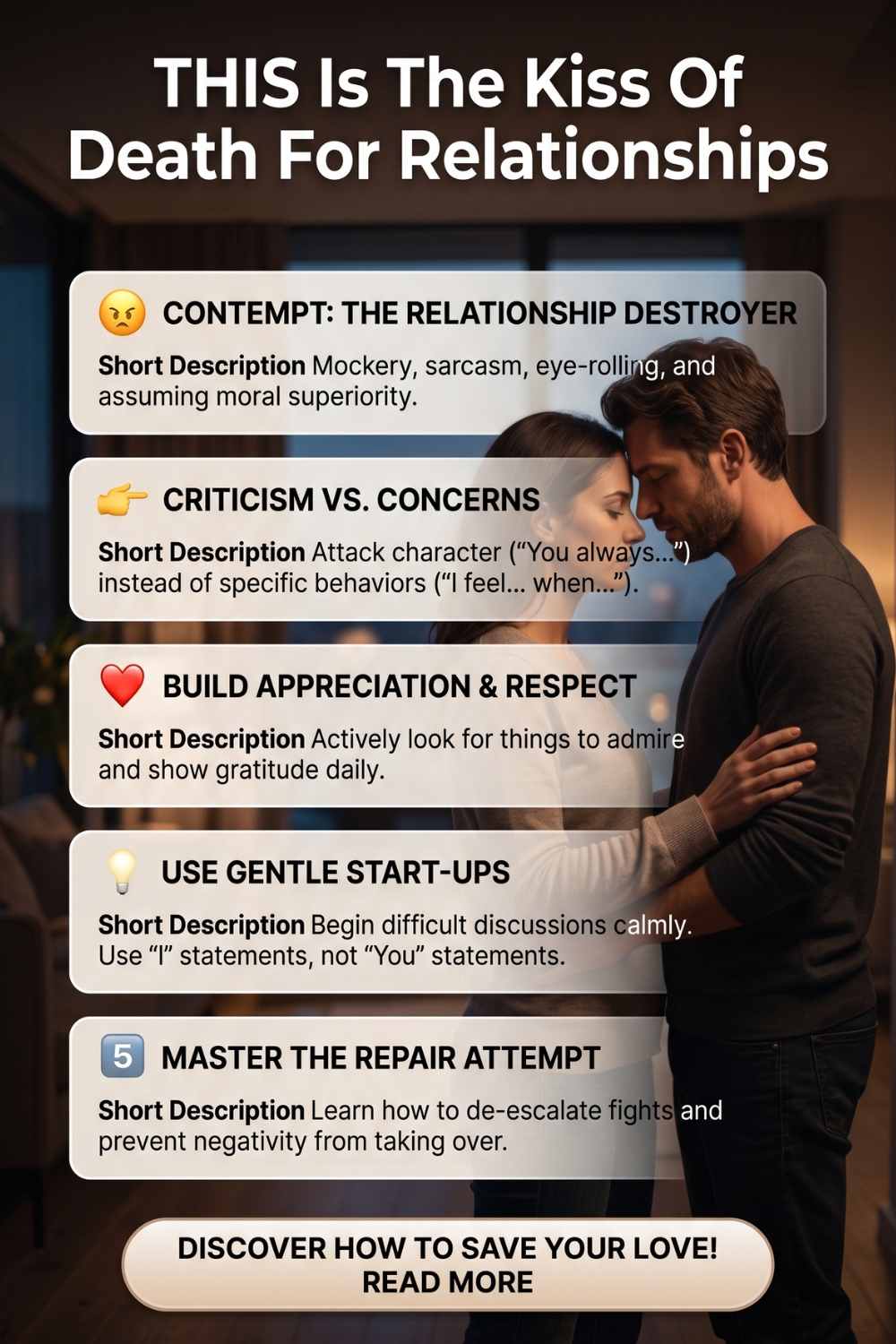

We all enter into partnerships with high hopes, dreaming of achieving those perfect relationship goals we see plastered across our Pinterest feeds. But behind closed doors, even the most passionate romances can slowly unravel. You might think that major betrayals like infidelity or financial ruin are the primary reasons couples split. While those are certainly devastating, psychological research and expert relationship advice point to something much more insidious.
There is one specific behavior—a quiet, everyday habit—that relationship experts universally agree is the ultimate predictor of a breakup.
If you are looking for genuine love advice to save your partnership or simply want to ensure your connection remains unbreakable, understanding this dynamic is crucial. Let’s dive deeply into what experts call the true “kiss of death” for a relationship, how to recognize it, and the actionable relationship tips you need to reverse the damage before it is too late.
What Exactly Is The “Kiss Of Death” In A Relationship?
When we talk about the “kiss of death,” we are referring to contempt.
According to Dr. John Gottman, a leading psychological researcher renowned for his ability to predict divorce with over 90% accuracy, contempt is the most destructive negative behavior a couple can engage in. It is the absolute antithesis of love goals.
But what does contempt actually look like? It’s not just passing anger or everyday frustration. Contempt is a toxic cocktail of anger and disgust. It happens when one partner treats the other with disrespect, mocks them with sarcasm, ridicules them, calls them names, mimics them, or uses dismissive body language like eye-rolling or scoffing.
The Four Horsemen of the Relationship Apocalypse
To understand why contempt is so lethal, it helps to look at the broader framework of negative communication. Gottman identifies “The Four Horsemen” that signify deep trouble in a relationship:
-
Criticism: Attacking your partner’s character rather than addressing a specific behavior. (e.g., “You always leave the kitchen a mess, you are so lazy.”)
-
Defensiveness: Playing the victim to ward off a perceived attack, refusing to take responsibility.
-
Stonewalling: Withdrawing from the interaction entirely, shutting down, and simply refusing to engage.
-
Contempt: Assuming a position of moral superiority over your partner. (e.g., “I would never make such a stupid financial mistake, what is wrong with you?”)
Out of all four, contempt is the most poisonous because it conveys disgust. It is virtually impossible to resolve a conflict when one person feels disgusted by the other. This behavior fundamentally shatters the safety and trust required to maintain healthy relationship goals.
Recognizing Contempt: The Ultimate Relationship Advice
Often, contempt doesn’t start with shouting matches. It creeps in quietly. It builds up over time from unresolved resentments and a lack of appreciation. If you want the best relationship advice available, start by auditing how you and your partner speak to one another during moments of stress.
Signs You Might Be Sabotaging Your Love Goals
Are you or your partner exhibiting these subtle (or not-so-subtle) signs of contempt?
-
Sarcasm and Cynicism: Using a biting tone to belittle your partner’s ideas or feelings.
-
Hostile Humor: Making jokes at your partner’s expense, especially in front of others, and then claiming “I was just kidding” when they get upset.
-
Name-Calling: Resorting to labels like “idiot,” “childish,” or “selfish” during an argument.
-
Dismissive Body Language: The classic eye-roll, crossing arms defensively, or physically turning away when your partner is speaking.
When these behaviors become the norm, they erode the immune system of the relationship. In fact, studies show that couples who exhibit high levels of contempt are actually more prone to infectious illnesses because of the severe physiological stress it causes.
Essential Love Tips to Reverse the Damage
If you recognize the kiss of death in your own dynamic, do not panic. The presence of contempt does not mean your partnership is automatically doomed, provided both people are willing to put in the work to change it.
Here are the most effective love tips to eradicate contempt and rebuild a culture of fondness and admiration.
1. Cultivating Respect and Appreciation
The direct antidote to contempt is building a culture of appreciation. You cannot feel disgusted by someone you are actively finding reasons to admire.
-
Actionable Tip: Start a daily gratitude habit. Every day, find one specific thing your partner did that you appreciate and tell them out loud. It doesn’t have to be massive. “Thank you for making the coffee this morning, it really helped me get my day started” goes a long way.
2. Practice Gentle Start-Ups
How a conversation begins usually dictates how it will end. If you start a discussion with a harsh criticism, it will likely end in a fight.
-
Actionable Tip: Use “I” statements instead of “You” statements. Instead of saying, “You never help with the chores,” reframe it as, “I am feeling overwhelmed with the housework today, could you please help me with the laundry?”
3. Build Your “Love Maps”
In healthy relationships, partners know each other intimately. They know each other’s stresses, hopes, and daily realities. Gottman calls this having a detailed “Love Map.”
-
Actionable Tip: Ask open-ended questions. Instead of “How was work?” try asking, “What was the most challenging part of your day today?” Show genuine curiosity about their inner world.
Communication Habits for Long-Lasting Relationship Goals
Achieving those picture-perfect relationship goals isn’t about grand romantic gestures; it is about the micro-moments of connection that happen every single day.
Active Listening and Empathy
When your partner is upset, your job isn’t always to fix the problem. Often, it is simply to validate their emotions.
When you validate your partner, you are telling them that their feelings make sense. This is profound relationship advice because it neutralizes defensiveness. Even if you don’t agree with their perspective, you can say, “I understand why you feel that way, and it makes sense to me why that would upset you.”
Repair Attempts: The Secret Weapon
Happy couples still fight. The difference between a happy couple and a miserable one is their ability to make and receive “repair attempts.”
A repair attempt is any statement or action—silly or serious—that prevents negativity from escalating out of control. It could be making a goofy face, offering a self-deprecating joke, or simply saying, “Can we take a time-out? I’m getting too heated.” Recognizing and accepting your partner’s repair attempts is a critical relationship tip for longevity.
When to Seek Professional Love Advice
Sometimes, despite our best efforts, the resentment is too deep to untangle on our own. There is absolutely no shame in seeking professional help. In fact, proactive couples counseling is one of the most intelligent relationship goals you can set.
Consider seeking a licensed marriage and family therapist if:
-
Arguments constantly loop without ever finding a resolution.
-
You feel more like roommates than romantic partners.
-
The “Four Horsemen” (especially contempt) are present in most interactions.
-
There has been a major breach of trust.
A professional can provide customized, unbiased love advice and give you the communication frameworks necessary to break toxic cycles.
Frequently Asked Questions (FAQ)
Q: Can a relationship survive after contempt has become a habit?
A: Yes, but it requires immediate intervention. Both partners must recognize the toxic behavior, take accountability for their part in it, and actively work to build a culture of appreciation and respect to replace the contempt.
Q: What are the best daily relationship tips for busy couples?
A: The most effective daily habits include the “six-second kiss” (which is long enough to trigger oxytocin release), sharing a 20-minute stress-reducing conversation at the end of the day, and expressing genuine appreciation for one small thing your partner did.
Q: Are “relationship goals” we see on social media realistic?
A: Most social media portrays curated highlight reels. True relationship goals should focus on emotional safety, mutual respect, healthy conflict resolution, and consistent support, rather than just aesthetically pleasing moments.
Q: How do we stop arguing about the same things over and over?
A: Gridlocked arguments usually stem from unfulfilled core dreams or values. Stop trying to “win” the argument and start digging into the underlying meaning behind your partner’s stance. Empathy and compromise are key.
Conclusion
The true kiss of death for any partnership isn’t a single explosive event; it is the slow, quiet rot of contempt. When eye-rolls, sarcasm, and disrespect replace warmth and admiration, the emotional foundation of the partnership crumbles.
However, by understanding this dynamic, you hold the power to change it. By applying this relationship advice—focusing on appreciation, practicing gentle communication, and actively listening—you can safeguard your partnership against the Four Horsemen.
Remember, healthy relationship goals are not found in grand, cinematic gestures, but in the quiet, daily choices to treat your partner with respect, empathy, and enduring kindness.
What is one small thing you can do today to show appreciation for your partner?