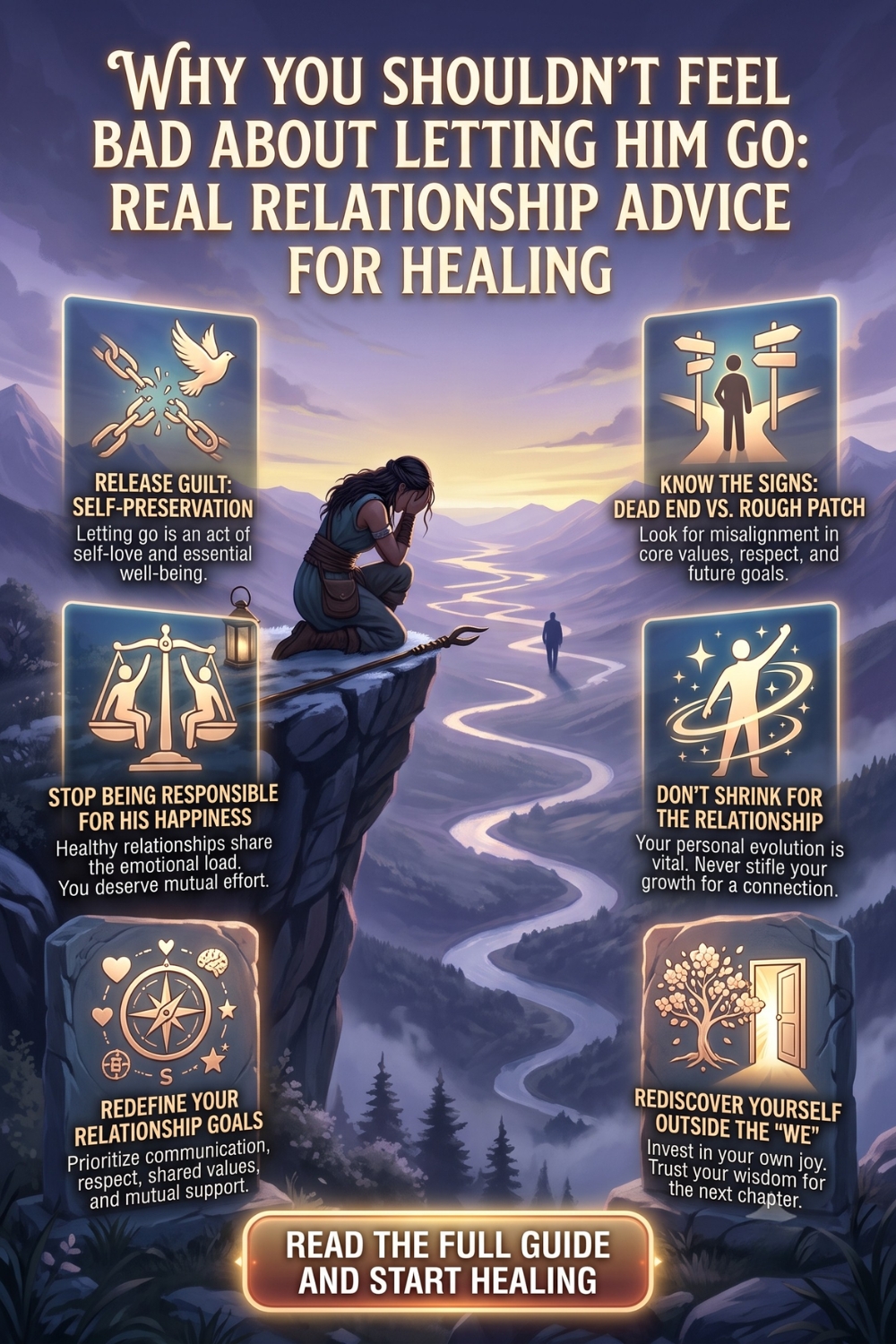

Introduction: The Heavy Burden of Holding On
Making the choice to end things with a partner is rarely something that happens overnight. It usually comes after months—sometimes years—of quiet doubts, tearful conversations, and hoping things will magically change. When you finally reach the point where you know it is time to walk away, a new, unexpected emotion often takes over: guilt. You might wonder if you didn’t try hard enough, if you are throwing away something good, or if you will regret this decision forever.
If you are looking for honest relationship advice, here is the truth: you do not have to feel bad about letting him go.
What does letting go in a relationship mean? In healthy relationships, letting go means recognizing that a partnership is no longer serving the growth, happiness, or well-being of one or both individuals. It is the conscious decision to release the emotional ties to a person when the connection has run its course, prioritizing your peace over the comfort of familiarity.
In this comprehensive guide, we are going to explore why releasing that guilt is the most important step in your healing journey. We will dive deep into practical love tips, help you redefine your relationship goals, and show you how to move forward with confidence. Whether you are currently on the fence about leaving or you have already packed your bags, this advice is designed to help you find your footing again.
Why Letting Go is Sometimes the Best Relationship Advice
We are often taught that successful relationships require endless compromise. Society tells us that if you just work a little harder, communicate a little better, or love a little stronger, any relationship can be saved. But real relationship advice acknowledges a difficult truth: not every connection is meant to last a lifetime.
Recognizing When Love Advice Means Walking Away
One of the most challenging aspects of modern dating is distinguishing between a rough patch and a dead end. A rough patch is when external stressors—like career changes, financial issues, or health scares—temporarily disrupt your connection. A dead end is when your core values, your vision for the future, or your mutual respect have fundamentally misaligned.
When you seek out love advice from friends, family, or even professionals, the focus should not solely be on “how to fix him” or “how to fix the relationship.” Sometimes, the most profound advice is learning how to gracefully exit a situation that is draining your energy. If you are consistently compromising your own boundaries, values, or mental health to keep the peace, walking away is not a failure; it is an act of self-preservation.
The Myth of the “Perfect” Relationship
Social media often bombards us with images of flawless couples, painting a picture of what relationship goals should look like. It is easy to compare your messy, complicated reality to these curated highlight reels. This comparison can fuel your guilt. You might think, “If I just tried harder, we could be like that.”
But behind every aesthetic photo and matching outfit is a real, complex dynamic. Striving for perfection will only keep you trapped in a cycle of disappointment. Letting go of a partner who doesn’t fit your life anymore is the first step toward finding a love that is authentic, rather than just visually appealing.
Top Relationship Tips: How to Release Guilt When It Ends
Guilt is a heavy emotion. It can convince you to stay in situations that actively harm your spirit. Releasing this guilt requires a conscious, daily effort to reframe how you view the end of the relationship.
Understanding Your Emotional Pain Points
Guilt usually stems from a place of deep empathy. You do not want to hurt him. You do not want to disrupt the life you have built together. You might even feel responsible for his emotional well-being. However, you must differentiate between caring for someone and being responsible for them.
-
You are not responsible for his happiness: A mature relationship involves two whole individuals sharing their lives, not one person constantly propping up the other.
-
Pain is temporary, regret is long-term: The immediate pain of a breakup is intense, but staying in the wrong relationship leads to a slow, suffocating regret that lasts much longer.
-
You deserve mutual effort: If the emotional labor has been entirely one-sided, feeling guilty about leaving is a conditioned response, not a logical one.
Prioritizing Your Personal Love Goals Over Guilt
When was the last time you thought about your own love goals? Not the goals you compromised on to make the relationship work, but your actual, unedited desires for partnership. Letting him go is the necessary space-clearing required to bring those goals to life.
Take a notebook and write down exactly what you want your future to look like. Do you want a partner who communicates openly? Someone who shares your ambition? Someone who matches your effort? When you clearly define these relationship goals, the guilt of leaving a situation that doesn’t meet them begins to fade. You are making room for what truly aligns with your spirit.
Identifying When the “Love Goals” Don’t Align Anymore
People change. It is a fundamental fact of life. You are not the same person you were five years ago, and neither is he. Sometimes, two people grow in parallel lines, and sometimes, those lines diverge completely.
Growth Outpaces the Relationship
Have you ever felt like you are outgrowing your own life? Perhaps you have started prioritizing your mental health, focusing on your career, or discovering new passions, while he has remained stagnant. This is a common pain point. You might try to pull him along on your growth journey, sharing podcasts, suggesting books, or initiating deep conversations, only to be met with resistance or apathy.
It is heartbreaking to realize that your personal evolution is incompatible with your current relationship. But feeling bad about outgrowing someone is like feeling bad that you no longer fit into your childhood clothes. It is a natural progression. Your relationship advice takeaway here is simple: never shrink yourself to fit into a space you have clearly outgrown.
Emotional Exhaustion vs. Normal Conflict
Conflict is normal. Relationships require negotiation and healthy debate. However, there is a distinct difference between productive conflict and emotional exhaustion.
Productive conflict ends with a resolution, mutual understanding, and a plan to move forward. Emotional exhaustion is having the exact same argument for the fiftieth time with absolutely no change in behavior. If you are entirely drained by the mere thought of interacting with your partner, or if your body physically tenses up when he enters the room, your nervous system is giving you a very clear signal. Listen to it. Letting go is the ultimate remedy for this kind of deep-seated fatigue.
Actionable Love Tips for Healing and Moving Forward
Once the decision is made and the relationship is over, the real work begins. Healing is not linear, and there will be days when the guilt tries to creep back in. Having a toolkit of actionable strategies will help you stay grounded.
Finding Comfort in Love Quotes and Shared Experiences
Sometimes, putting your feelings into words is too difficult. This is where leaning on the wisdom of others can be incredibly therapeutic. Reading love quotes or passages about moving on can provide a strange but profound comfort—it reminds you that you are not the first person to feel this specific type of heartbreak, and you certainly won’t be the last.
“Sometimes it takes a heartbreak to shake us awake and help us see we are worth so much more than we’re settling for.” — Mandy Hale
Surround yourself with media, books, and articles that validate your experience. Build a support system of friends who remind you of your strength when you forget it.
Setting Boundaries for Future Relationships
The end of one chapter is the perfect time to write the rules for the next. What did this past relationship teach you about your boundaries?
-
Identify Dealbreakers: What behaviors will you absolutely not tolerate moving forward? (e.g., poor communication, disrespecting your time, lack of ambition).
-
Establish Communication Standards: Decide how you want conflict to be handled in the future.
-
Protect Your Energy: Learn to say “no” without providing an essay of justification.
These relationship tips aren’t just about finding the next partner; they are about becoming the most secure version of yourself.
Rebuilding Your Life: Setting New Relationship Goals
The aftermath of letting someone go is often described as an empty space. Instead of viewing this space as a void, try looking at it as a blank canvas. This is your opportunity to rebuild your life exactly how you want it.
Rediscovering Who You Are Outside of the Relationship
When you are part of a “we” for a long time, the “I” can get lost. You might have forgotten what you like to do on a Sunday morning when you don’t have to compromise with someone else.
Take this time to date yourself. Revisit hobbies you abandoned. Decorate your living space exactly how you want it. Travel to the places he never wanted to go. By investing heavily in your own joy, you solidify the fact that letting him go was the right choice. You will find that the best relationship you can cultivate right now is the one you have with yourself.
How to Trust the Next Chapter
It is normal to feel cynical about love after a tough breakup. You might worry that all your future relationships will end the same way. To combat this, you need to consciously reshape your mindset around your relationship goals.
Understand that every failed relationship is simply data. It is information that tells you exactly what you do not want, pushing you closer to what you do want. Trusting the next chapter requires you to trust yourself first. Trust that you now have the wisdom to spot red flags earlier. Trust that you have the courage to walk away if things aren’t right. And most importantly, trust that you are entirely whole on your own.
FAQ: Expert Relationship Advice for Letting Go
1. How do I know if I’m letting him go too soon? If you have clearly communicated your needs, given him reasonable time to make changes, and you are still feeling unfulfilled, emotionally drained, or disrespected, you are not acting too soon. Consistent lack of effort or refusal to change harmful behaviors is a clear sign that it is time to move on.
2. Is it normal to feel guilty even if he was toxic? Absolutely. Empathy doesn’t just switch off because someone treated you poorly. Trauma bonding and the desire to “fix” a situation can create intense feelings of guilt when you finally leave. Acknowledge the feeling, but do not let it dictate your actions. Your safety and mental health must come first.
3. What is the best relationship advice for handling mutual friends after a breakup? Maintain boundaries. You do not need to explain your reasons for leaving to everyone. Offer a polite, brief explanation if necessary, but refuse to engage in gossip or mudslinging. True friends will support your decision to prioritize your well-being.
4. How can I redefine my relationship goals after a major breakup? Start by looking inward. Write down what made you unhappy in the past and flip it to create a new goal. If lack of communication was the issue, your new goal is finding a partner who values transparency. Keep these goals focused on mutual respect, shared values, and emotional safety.
Conclusion: Your Peace is Worth the Price
Letting someone go is one of the most painful, courageous things you can do. It requires you to look at a situation you poured your heart into and admit that it is no longer working. It requires you to face the unknown.
But as you navigate this transition, keep this crucial piece of relationship advice at the front of your mind: your peace is worth the price of letting go. Do not let guilt convince you to stay in a room where the air has run out. You deserve a love that feels light, a partnership that encourages your growth, and a life that you are excited to wake up to.
If you are ready to continue your journey of self-discovery and empowerment, take a moment to reflect on your own boundaries today. Write down three things you will no longer tolerate in your life, and use them as your compass moving forward. You’ve got this.