
There are few feelings more exhausting than being unable to stop thinking about someone.
Maybe it was an ex you thought you’d spend forever with. Perhaps it’s a situationship that ended without closure. Maybe it’s someone you never officially dated but somehow managed to occupy your thoughts every waking moment. Regardless of how the connection started, obsession can leave you emotionally drained, distracted, and stuck in a cycle that feels impossible to escape.
You replay conversations. You analyze texts. You wonder what they’re doing, who they’re with, and whether they’re thinking about you too. You tell yourself you’ll stop checking their social media, yet somehow find yourself scrolling through their profiles again just a few hours later.
The hardest part is that you often know the obsession isn’t helping you. You understand it’s preventing you from moving on. Yet knowing that and actually letting go are two very different things.
The good news is that obsession isn’t love, and it’s not permanent. It’s often a combination of emotional attachment, habit, fantasy, loneliness, and unresolved feelings. Once you understand what’s fueling it, you can begin taking practical steps to regain control of your thoughts and emotions.
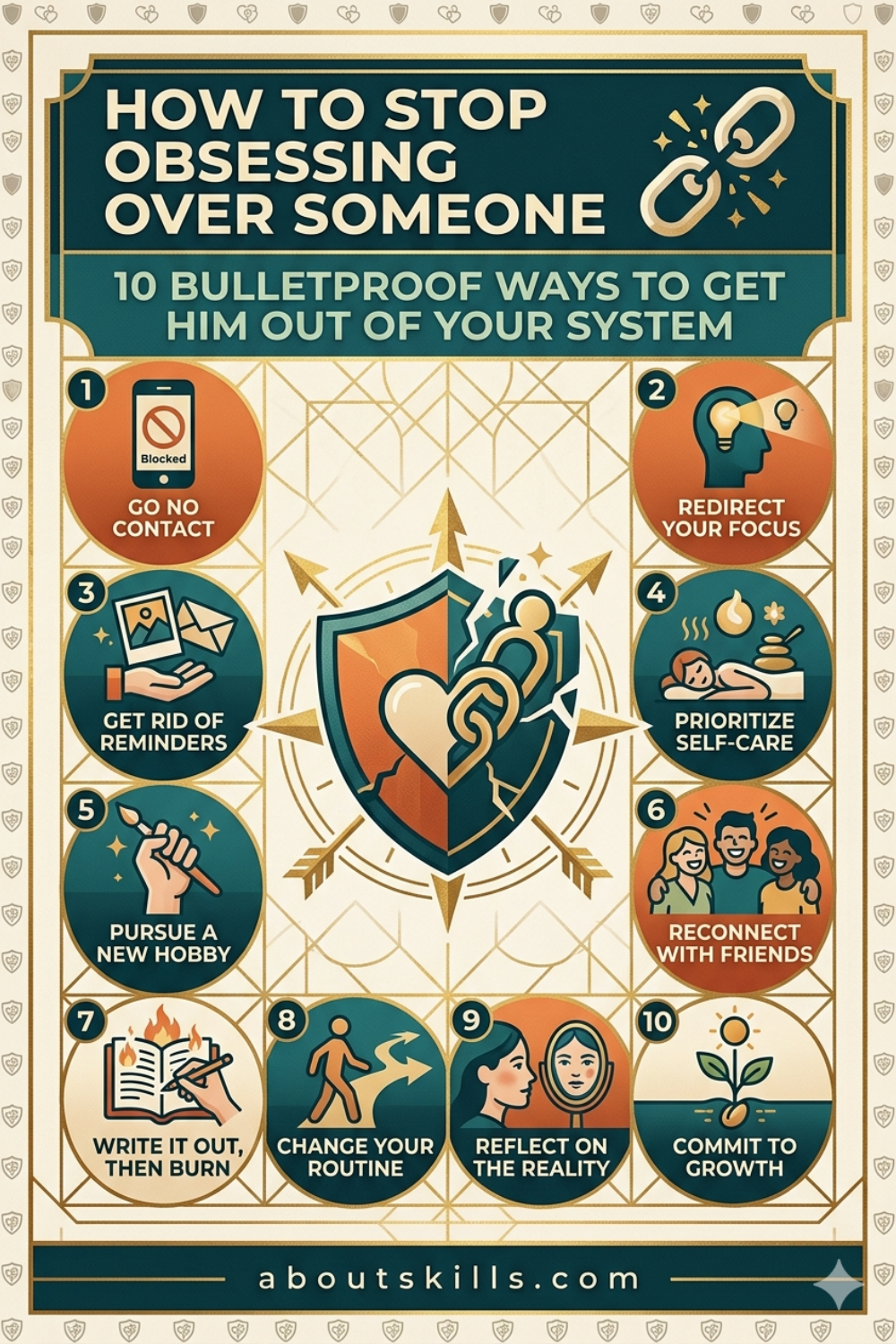
If you’re ready to stop giving someone free rent in your head, here are ten bulletproof ways to get him out of your system and reclaim your peace of mind.
Accept That You’re Probably In Love With The Idea Of Him
One of the biggest reasons people stay obsessed with someone is because they’re no longer attached to reality.
They’re attached to potential.
When you obsess over someone, your mind tends to focus on the best parts while minimizing the negatives. You remember the chemistry, the excitement, the compliments, and the moments that made you feel special. Meanwhile, you conveniently forget the mixed signals, disappointment, inconsistency, or reasons the relationship didn’t work. Over time, the person in your imagination becomes more appealing than the actual person.
That’s why one of the first steps toward freedom is seeing them clearly. Ask yourself whether you’re obsessed with who they truly are or who you hoped they would become. The answer is often surprisingly revealing. When fantasy loses its grip, obsession usually begins losing its power as well.
Stop Looking For Signs, Clues, And Hidden Meanings
Obsession thrives on uncertainty. When people don’t have clear answers, they often try to create them. You may find yourself analyzing every interaction for hidden meaning. You reread old messages searching for clues. You wonder whether that social media post was secretly about you. You convince yourself that every coincidence must mean something significant.
Unfortunately, this behavior keeps emotional attachment alive. The more time you spend investigating, decoding, and interpreting, the more mental energy you continue investing in someone who is no longer contributing to your life.
Not every unanswered question requires an answer. Sometimes closure comes from deciding that you no longer need one. The moment you stop searching for hidden messages is often the moment your mind begins finding peace.
Create Distance Between Yourself And The Source Of The Obsession
It’s extremely difficult to stop thinking about someone when you’re constantly exposed to reminders of them. Every photo, message, profile visit, and online update acts as fuel for the obsession. Many people resist creating distance because they’re afraid of letting go completely. They convince themselves that checking in occasionally won’t hurt. Unfortunately, occasional contact often becomes emotional reinforcement.
Each interaction reactivates old feelings and restarts the cycle. Creating distance doesn’t necessarily mean blocking someone forever. It simply means reducing unnecessary exposure while you heal. Mute their social media accounts. Stop revisiting old conversations. Remove constant reminders from your environment. Distance allows your emotions to settle. Without new stimulation, your mind gradually stops treating the person as an active part of your life.
Understand That Obsession Is Often A Habit
Most people think obsession is entirely emotional. In reality, it often becomes behavioral. You wake up and think about him. You check your phone. You replay memories during your commute. You stalk social media before bed. Eventually, these behaviors become routines. Your brain begins following familiar pathways automatically. This is important because habits can be changed.
Every time you notice yourself slipping into obsessive thinking, gently redirect your attention elsewhere. Read a book. Call a friend. Exercise. Work on a project. The goal isn’t to suppress thoughts. The goal is to stop feeding them. Over time, new habits replace old ones, and the obsession gradually loses momentum.
Stop Romanticizing The Pain
Some people become attached not only to the person but also to the emotional experience itself.
Heartbreak can feel strangely comforting because it provides a sense of purpose. Thinking about someone gives you something to focus on. Longing creates emotional intensity. Sadness becomes familiar. Without realizing it, you begin romanticizing your suffering. You play sad songs. You revisit painful memories. You repeatedly place yourself in situations that trigger emotional reactions.
Healing requires letting go of the identity you’ve built around the heartbreak. Your pain is not proof of your love. Your suffering is not evidence that the connection was meant to be. You can honor what you felt without remaining trapped by it.
Fill The Empty Space With Something Meaningful
One of the biggest mistakes people make after a breakup or emotional loss is focusing entirely on what they’re trying to remove. They’re so determined to stop thinking about someone that they forget to build a life worth thinking about instead. Obsession often leaves a void. The solution isn’t simply eliminating thoughts of him.
The solution is creating new experiences, goals, and sources of fulfillment that naturally occupy your attention. Learn a new skill. Join a class. Pursue a fitness goal. Travel. Reconnect with friends. Explore interests you’ve neglected. The more meaningful your own life becomes, the less appealing it feels to spend hours living inside memories. A full life leaves less room for obsession.
Challenge The Story You’re Telling Yourself
Obsession often survives because of the narratives we create. You may believe he was the only person who truly understood you. You may convince yourself that you’ll never meet anyone like him again. You may tell yourself that losing him means losing your chance at happiness. These stories feel real because they’re repeated so often.
However, feelings are not facts. Ask yourself whether your beliefs are objectively true. Was he really the only person capable of making you happy? Was the relationship truly perfect? Is it realistic to assume you’ll never connect with anyone else? When you challenge these assumptions, you often discover that the obsession has been supported by exaggerations rather than reality.
Focus On What You Can Control
One reason obsession feels so consuming is because it revolves around things outside your control. You can’t control whether someone misses you. You can’t control their choices, feelings, or actions. You can’t force them to come back or become the person you hoped they would be. The more energy you invest in uncontrollable outcomes, the more powerless you feel.
Freedom begins when you shift your attention back to yourself. You can control your actions. You can control your habits. You can control how you spend your time. You can control the people you allow into your life. Focusing on what you can influence creates a sense of empowerment that obsession cannot provide.
Accept That Moving On Doesn’t Mean Forgetting
Many people fear letting go because they assume it means erasing the person entirely. That’s not how healing works. Moving on doesn’t require pretending someone never existed. It doesn’t mean deleting every memory or denying the impact they had on your life. It simply means releasing the emotional grip they currently have on you.
You can remember someone without obsessing over them. You can appreciate what you learned without wishing things were different. You can acknowledge the past while still choosing to move forward. Acceptance often feels less dramatic than people expect. It’s not a sudden moment. 3“It’s a gradual decision you make repeatedly until peace begins replacing longing.
Give It More Time Than You Think You Need
Perhaps the most important thing to remember is that healing rarely follows a schedule. People often become frustrated because they’re still thinking about someone weeks or months later. They assume something must be wrong with them. In reality, emotional attachment takes time to unwind. You spent weeks, months, or perhaps years building feelings for this person. It’s unrealistic to expect those emotions to disappear overnight.
Be patient with yourself. Progress is rarely linear. xSome days you’ll feel strong and confident. Other days old memories may return unexpectedly. Neither experience means you’re failing. As long as you’re moving forward, you’re healing. Time doesn’t magically solve everything, but when combined with intentional effort, it gradually weakens emotional attachment until the obsession no longer controls your thoughts.
Why Obsession Feels So Powerful
Obsessive thinking often creates the illusion that the person is uniquely important. In reality, the intensity usually comes from emotional uncertainty, unmet needs, fantasy, and habit rather than genuine compatibility. Your brain becomes hooked on the emotional highs and lows associated with the connection.
That’s why obsession can feel addictive. The good news is that what was learned can also be unlearned. The same brain that created the obsession is capable of creating healthier patterns.
Final Thoughts
If you’re struggling to stop obsessing over someone, remember that you’re not alone. Almost everyone experiences intense emotional attachment at some point in life. The key is recognizing that obsession isn’t a sign that you’re meant to be together. More often, it’s a sign that your mind has become trapped in a cycle of longing, fantasy, and emotional habit.
By accepting reality, creating distance, challenging unhealthy narratives, building a meaningful life, and focusing on what you can control, you’ll gradually loosen the hold this person has over your thoughts. Most importantly, be patient with yourself. Healing isn’t about forgetting someone overnight. It’s about reaching a point where thoughts of them no longer determine your happiness. And when that day arrives, you’ll realize something important: The peace you were searching for was never going to come from them. It was always going to come from you.