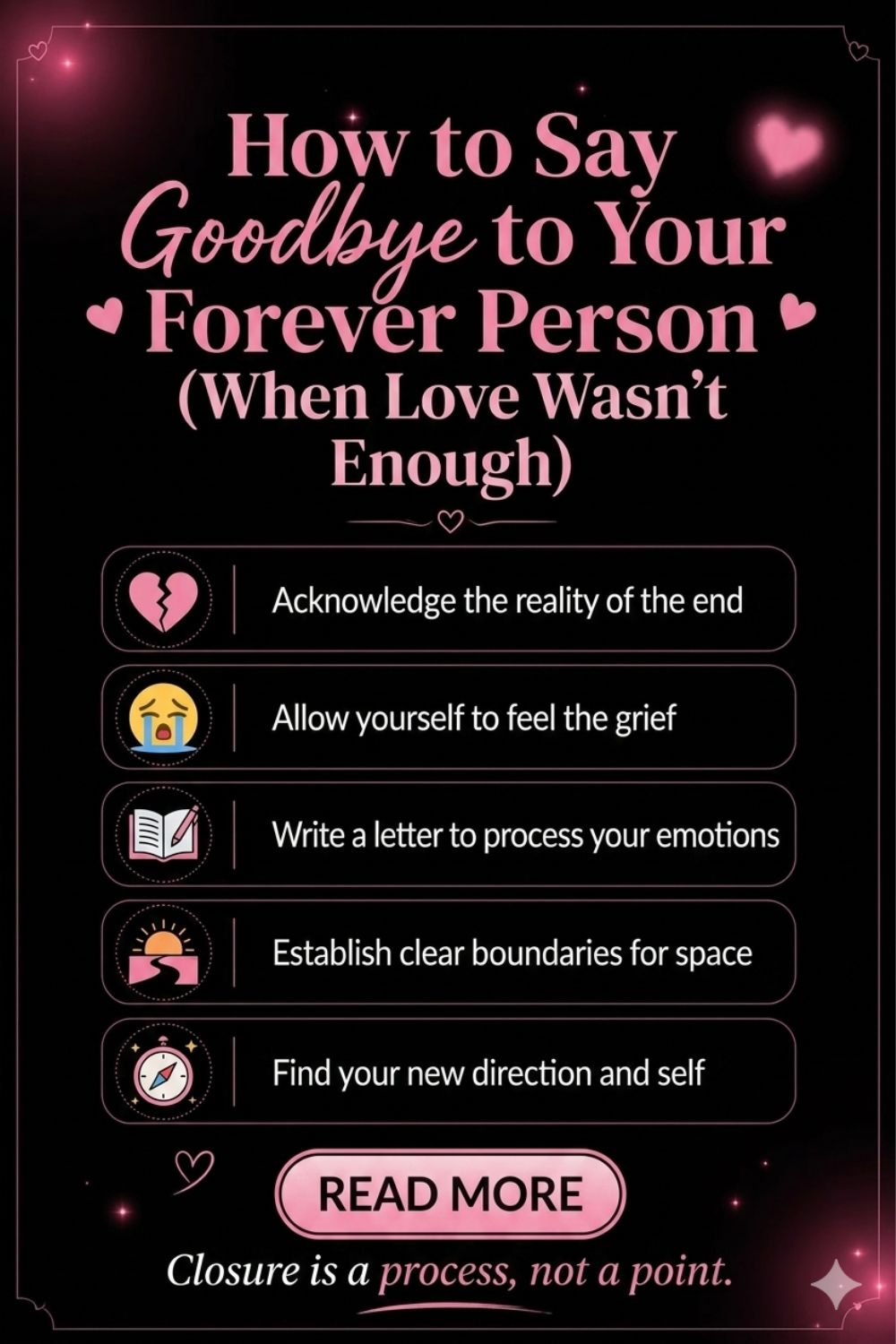

There’s a particular kind of grief reserved for losing someone you were certain you’d keep forever. Not a situationship. Not a casual fling that ran its course. The person. The one you built a future around in your mind without even meaning to — the one whose name you’d already, quietly, started attaching to the word “always.”
And then, somehow, impossibly, it ends anyway.
If you’re here, you already know this isn’t ordinary heartbreak. Ordinary heartbreak comes with some relief mixed in — the relationship wasn’t right, you both knew it, the ending feels almost merciful. This is different. This is grieving someone you loved correctly, who maybe loved you correctly too, and still couldn’t make the future work.
You’re not here because you don’t understand love. You’re here because you understood it completely, and it still wasn’t enough to keep them. This article is about what to do with that — how to actually say goodbye to your forever person, grieve the future you lost alongside the person, and find your way to healing without pretending the love wasn’t real.
Why Losing a “Forever Person” Hurts Differently
Before we get into the how, it’s worth understanding the why — because this grief operates differently than typical breakup pain, and understanding that difference is the first step toward healing it correctly.
Psychologists who study attachment and loss note that grief intensity is closely tied to the size of the imagined future that’s been lost, not just the relationship that existed in the past. When you believed someone was your forever person, you weren’t just attached to who they were — you were attached to an entire imagined life: the apartment you’d eventually share, the inside jokes that would calcify into family lore, the version of yourself you’d become alongside them.
Losing that isn’t just losing a person. It’s losing a future you’d already started living inside your head. That’s why this kind of heartbreak can feel disproportionately devastating compared to relationships that were shorter or less serious — you’re not just grieving what happened. You’re grieving what was never going to get the chance to happen at all.
Step 1: Stop Trying to Make the Ending Make Sense
One of the most exhausting parts of this kind of loss is the relentless mental loop: replaying conversations, searching for the exact moment things went wrong, trying to locate the one decision that could have changed everything.
Here’s something worth sitting with: some endings don’t have a clean, logical explanation, and searching for one indefinitely will only prolong your pain.
Sometimes the right person arrives at the wrong time. Sometimes two people love each other completely and are still incompatible in the practical architecture of daily life — different values around money, family, ambition, or geography that no amount of love can fully resolve. Sometimes circumstances outside anyone’s control — distance, timing, family obligations, health, finances — simply make a shared future impossible, regardless of how much both people wanted it.
Trying to assign blame or find the “real reason” can feel like control in the middle of chaos, but more often it just keeps the wound open. At some point, healing requires accepting a harder truth: love and compatibility are not the same thing, and a relationship can be full of real love and still not be sustainable.
Step 2: Resist the Urge to Erase Them From Your Memory
When the pain is fresh, the instinct to protect yourself often shows up as an impulse to delete everything — photos, messages, memories, even the feelings themselves. It feels like the fastest path to relief: if you can just stop thinking about them, surely the pain will stop too.
It won’t. And trying usually backfires.
Psychological research into thought suppression — most notably the work of psychologist Daniel Wagner on what’s called the “white bear problem” — consistently shows that actively trying not to think about something makes the brain more likely to fixate on it, not less. Suppressed grief doesn’t disappear. It resurfaces, often at less convenient times, with more intensity.
Instead of erasing the relationship, the more effective approach is integration — allowing the memory to exist as a real, valuable part of your history, without needing to relive it constantly or pretend it never happened.
This doesn’t mean keeping every photo visible on your phone’s home screen or replaying your favorite memories on a loop. It means giving yourself permission to acknowledge: this happened, it mattered, and it’s allowed to be part of my story without controlling my present.
Step 3: Let Yourself Grieve the Relationship as a Real Loss
There’s a strange kind of shame that often accompanies this type of grief — the sense that since the relationship technically “ended” rather than someone dying, the grief should somehow be smaller, faster, or more manageable.
It isn’t, and it doesn’t have to be.
Grief researchers, including those who study what’s known as ambiguous loss — loss without a clear, finalized ending, like a breakup, estrangement, or someone choosing to leave — note that this type of grief can be just as intense and complicated as bereavement, sometimes more so, precisely because there’s no clear ritual or social permission to grieve it fully.
Give yourself that permission anyway. Cry when you need to. Talk about it when you need to. Feel the full weight of what you lost — not just the person, but the version of your life that included them. This loss deserves real grief, not a rushed, minimized version of it because no one died.
Step 4: Reframe What the Relationship Meant (Without Minimizing It)
As the rawest pain begins to soften, it helps to start gently reframing the relationship — not to diminish what it was, but to place it accurately within the larger story of your life.
Here’s a reframe worth holding onto: the relationship didn’t fail simply because it ended. A relationship’s value isn’t measured only by its longevity. Some relationships exist to teach you what real love feels like, to heal a wound you didn’t know you carried, or to show you, definitively, what you’re capable of feeling and deserving — even if that particular person wasn’t meant to be the one you build the rest of your life with.
This person may have been exactly what you needed at exactly the time you needed it, without being who you needed for the next fifty years. Both things can be true. The relationship can be both meaningful and finished.
Step 5: Let Go of the Idea That You’ll Never Feel This Way Again
One of the cruelest thoughts that surfaces after losing a forever person is the conviction that this was your one shot — that this depth of love was a singular, unrepeatable event, and that everything after this will be a lesser version of what you had.
This belief, while completely understandable in acute grief, is not actually supported by what we know about human capacity for connection. The brain’s capacity for attachment doesn’t diminish with use. If anything, having loved deeply once tends to clarify — not limit — your ability to recognize and build deep connection again, because you now know, with certainty, what it actually feels like.
You are not protecting yourself by deciding in advance that nothing will compare. You’re simply pre-grieving a future that hasn’t happened yet, on top of the grief you’re already carrying. Let this loss be specific to this person and this chapter — not a verdict on your entire emotional future.
Step 6: Become Your Own “Forever Person”
Here’s a truth that tends to get lost in the romance of soulmate language: the only person guaranteed to be with you for the entirety of your life is you.
This isn’t a consolation prize. It’s the foundation everything else gets built on.
In the wake of losing someone you expected to keep forever, redirecting some of that devotion inward isn’t a defense mechanism — it’s recalibration. Invest in yourself the way you invested in them. Show up for your own needs the way you showed up for theirs. Build the kind of internal stability that doesn’t depend on another person’s permanence to feel secure.
The relationship you have with yourself is the only one you can guarantee will last a lifetime. Treat it accordingly, especially now.
Step 7: Allow the Memory to Become a Gift, Not a Wound
Eventually — not on any fixed timeline, and not in a way you can force — the memory of this person tends to shift. It moves from something that aches every time it surfaces to something closer to gratitude: a quiet acknowledgment that you got to experience something many people search for their entire lives and never find.
You don’t have to rush toward that reframe. Grief has its own pace, and trying to force gratitude before you’re ready often just creates another layer of suppression. But it helps to know that this shift is possible, and common, and waiting for you on the other side of the hardest part.
Some people will rent a permanent, quiet room in your heart without occupying your present life. That’s not a tragedy. That’s what it means to have loved someone real.
What Healing Actually Looks Like (Not the Movie Version)
Healing from this kind of loss rarely looks like the clean, linear “moving on” narrative we’re sold in films. Real healing tends to be messier and far more honest:
- Some days you’ll feel completely fine, and then a song or a smell will undo you entirely.
- You’ll have moments of genuine peace followed by sudden waves of missing them, sometimes months later.
- You’ll start to feel like yourself again, then feel guilty for feeling okay, as if healing is somehow a betrayal of how much they mattered.
- Eventually — gradually, unevenly — the good days will outnumber the hard ones, and one day you’ll realize you’ve gone an entire week without the ache showing up uninvited.
None of this is failure. This is what real grief, processed honestly, actually looks like.
Conclusion: Some Goodbyes Are a Tribute, Not a Tragedy
Saying goodbye to your forever person doesn’t mean the love wasn’t real, that you wasted your time, or that you’ll never feel that depth of connection again. It means you were brave enough to love completely, even knowing — somewhere underneath the certainty — that nothing in life actually comes with guarantees.
You don’t have to erase them to heal. You don’t have to pretend it didn’t matter to move forward. You simply have to let the love exist where it belongs now: not in your present, but in the part of your history that shaped who you’re becoming next.
You will survive this. You will love again — possibly even more fully, because you now know exactly what real love feels like, and what it costs, and that you’re capable of surviving its loss with your heart still fundamentally intact.