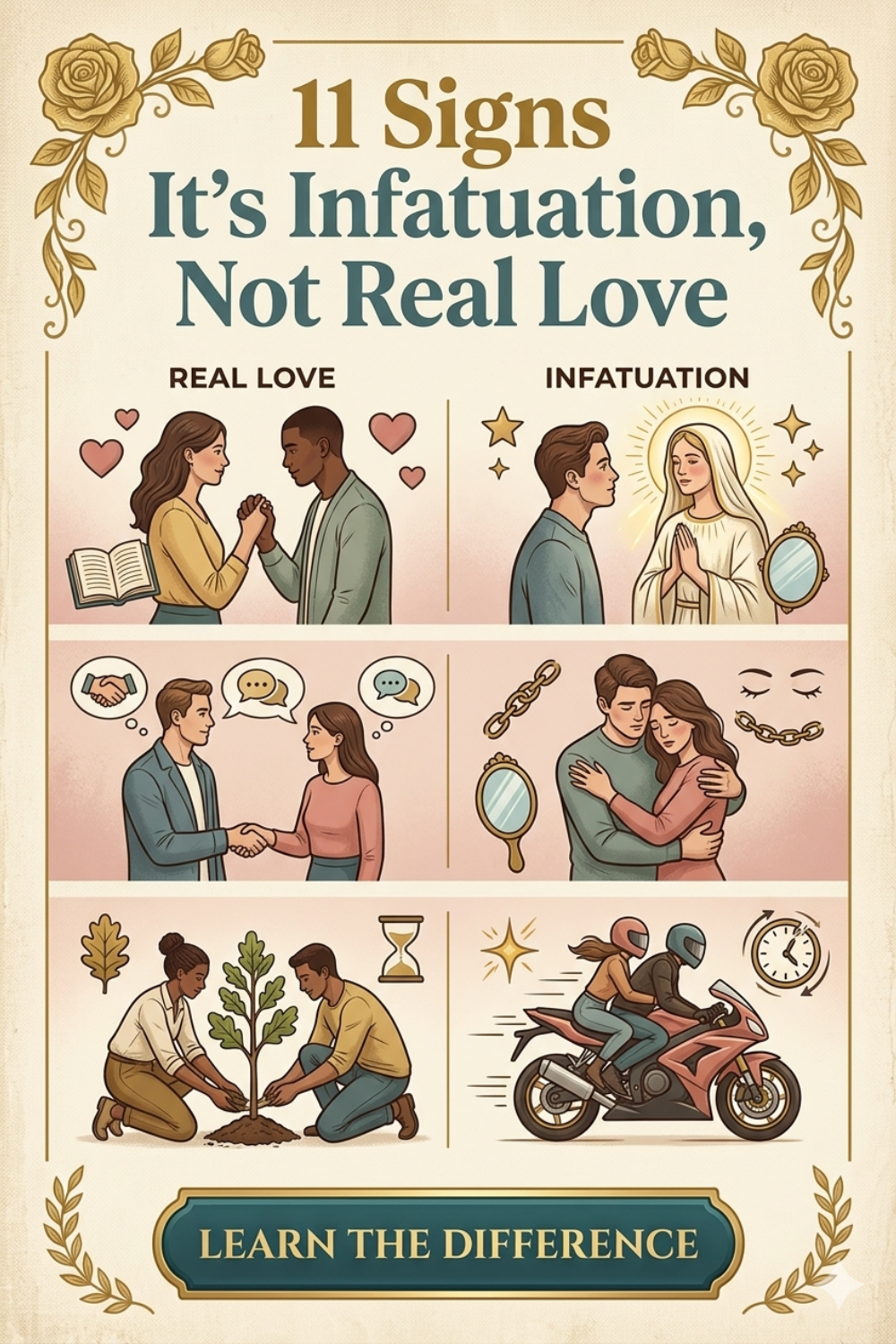

Few feelings are as intense, consuming, and confusing as new romantic infatuation. It can feel exactly like love — maybe even more intense than love, which is part of what makes it so disorienting. You think about this person constantly. Everything about them feels remarkable. And yet, something about it doesn’t quite match what you understand love to actually be.
The core difference comes down to this: infatuation is an intense, often short-lived passion, while love is a deeper affection that develops over time and tends to hold up under real-world conditions. The tricky part is that infatuation is genuinely powerful — powerful enough to convince you it’s love, at least for a while.
Here are 11 signs it’s infatuation, not real love — along with the psychology behind why infatuation feels the way it does, and what to look for instead.
Why Infatuation Can Feel Even More Intense Than Real Love
Before the list, it helps to understand the biology at play. What’s commonly called infatuation closely resembles what psychologist Dorothy Tennov termed “limerence” — an intense, involuntary state of romantic obsession marked by intrusive thoughts about another person and a powerful desire for reciprocation.
This state is associated with elevated dopamine and norepinephrine — the same neurochemical pathways involved in reward-seeking and even addiction. That’s part of why infatuation can feel so consuming: your brain is, quite literally, responding to this person the way it might respond to any other intensely rewarding stimulus. It’s real. It’s just not the same thing as love.
1. You’ve Only Known Each Other a Short Time
Real love takes time to develop because it requires actual familiarity — shared experience, observed behavior across different situations, and the gradual building of trust. If you’ve known someone for a short period and already feel certain you’re in love, what you’re likely experiencing is the early intensity of attraction and idealization, not the deeper bond that love requires time to build.
This doesn’t mean strong early feelings are meaningless — they can absolutely become real love. It just means they aren’t there yet, no matter how intense they feel.
2. You’re Focused on What You Want From the Relationship
It’s natural to imagine a future with someone you’re excited about. The distinction worth noticing is whose perspective that future is built around. If you’re mainly picturing what you want — how this relationship benefits you, fulfills you, completes some picture of your life — without equally considering what your partner wants or needs, that imbalance points toward infatuation rather than love.
Genuine love involves a real interest in the other person’s needs and a willingness to compromise around them, not just your own vision of how things should unfold.
3. You Can Only See Their Best Qualities
Idealization is one of the clearest markers of infatuation. When you’re infatuated, you tend to place the other person on a pedestal — seeing only their strengths and positive traits while remaining genuinely blind to their flaws, even ones that might bother you in anyone else.
Real love involves seeing someone clearly — flaws, imperfections, and all — and caring about them anyway. If you can’t yet identify a single real flaw in your partner, it likely means you don’t know them well enough yet, not that they’re flawless.
4. You Feel Like You’ve Won the Lottery
Infatuation often comes with an almost euphoric, can’t-believe-my-luck quality — an intense focus on this one thing (or person) that can crowd out everything else in your life, including work, friendships, and other priorities.
Real love tends to work differently. Rather than narrowing your focus to one all-consuming thing, it tends to expand your capacity for the rest of your life — making you a more engaged friend, a more motivated person, someone building toward a fuller life rather than orbiting a single source of intensity.
5. You Feel Like You Know Them Completely (But Actually Don’t)
Infatuation often comes with a strong, almost certain sense that you deeply understand someone — what drives them, what they want out of life, who they really are — even when that sense isn’t based on much actual time spent together or real conversation.
This is a well-documented psychological pattern: early in attraction, we tend to fill in gaps in our knowledge of someone with idealized assumptions, rather than genuine understanding built through experience. Real love is built on actually knowing someone — through real conversations, observed behavior, and time — not on a feeling of closeness that outpaces the relationship’s actual depth.
6. You Experience Intense, Reactive Jealousy
A little jealousy is a normal human emotion, but infatuation often comes with an outsized version of it — instant suspicion or possessiveness any time someone else shows interest in your partner, paired with an urge to mark your territory, so to speak.
Real love tends to come from a place of security rather than anxiety. It’s rooted in genuine connection, not a constant undercurrent of fear that you might lose this person to someone more interesting.
7. You Feel Urgency to Move Things Forward Quickly
Infatuation often comes with pressure — a need to secure commitment quickly, fueled by an underlying fear that the feeling (or the person) might disappear if you don’t act fast.
Love generally doesn’t operate on urgency. It develops gradually, and people who are genuinely in love tend to enjoy that gradual process rather than racing to skip past it. If you feel a persistent anxious need to lock things down immediately, that pressure itself is often a signal of infatuation rather than secure, developed love.
8. You’re Drawn to Surface-Level Qualities
It’s common, early on, to be drawn to how someone looks, sounds, or carries themselves — that’s a normal part of attraction. The distinction is whether your connection has moved beyond that surface level to something rooted in who they actually are: their values, character, how they treat other people, what they believe in.
If most of what draws you to someone remains surface-level — appearance, charm, the way they make you feel in the moment — without much depth behind it yet, that’s infatuation. Love is connection to the internal, not just the external.
9. You’re Preoccupied With the Fear of Losing Them
If a missed call or an off mood from your partner sends you spiraling into anxious questions about whether you did something wrong or whether they’re pulling away, that level of reactivity often reflects insecurity rather than secure attachment.
Genuine love tends to come with a baseline sense of security — an understanding that your partner has good days and bad days, that occasional lapses don’t threaten the relationship’s foundation, and that the bond between you can handle normal human inconsistency without panic.
10. You Expect the Relationship to Be Perfect
Infatuation often comes paired with unrealistic expectations: no real conflict, no moments of insensitivity, constant happiness, nothing ever going wrong. When reality inevitably falls short of that fantasy, it can feel like something has gone seriously wrong with the relationship itself.
Real love makes room for imperfection. It accepts that disagreements happen, that people are sometimes thoughtless or distracted, and that working through those moments — rather than avoiding them entirely — is actually how deeper connection gets built.
11. The Relationship Feels Full of Drama
When infatuation is paired with insecurity and unrealistic expectations, the result is often a relationship that feels emotionally volatile — big highs, big lows, frequent conflict, intense reactions to relatively small things.
Real love tends to feel comparatively calm, even during disagreements. It’s not without difficulty, but it doesn’t typically come with constant emotional whiplash. If your relationship feels like a recurring cycle of drama rather than steady connection, that pattern is worth examining honestly.
So How Do You Know When It’s Become Real Love?
Psychologist Robert Sternberg’s well-known triangular theory of love describes love as composed of three elements: intimacy (closeness and connection), passion (attraction and desire), and commitment (the decision to maintain the relationship over time). Infatuation typically involves passion without much intimacy or commitment yet — which is exactly why it can feel so intense while still being incomplete.
Real love tends to develop as all three elements grow together: as passion is joined by genuine closeness and a mutual decision to build something lasting. This doesn’t happen overnight — and that’s the point. If what you’re feeling has those three elements present and growing, even imperfectly, you’re likely looking at something real. If it’s mostly intensity with little real intimacy or staying power yet, you’re likely still in the infatuation stage — which isn’t a bad thing, just an early one.
Final Thoughts
Infatuation isn’t something to be ashamed of or dismissed — it’s a real, powerful, often wonderful experience, and for many people, it’s the genuine starting point of real love. The key is recognizing it for what it is: an intense beginning, not yet the deeper thing it has the potential to become.
If you’ve recognized several of these signs of infatuation vs love in your current relationship, that doesn’t mean it’s doomed — it simply means you’re early in the process. Give it time, get to know the real person rather than the idealized version, and pay attention to whether intimacy and commitment grow alongside the initial passion. That’s how you’ll know whether what started as infatuation is becoming something lasting.