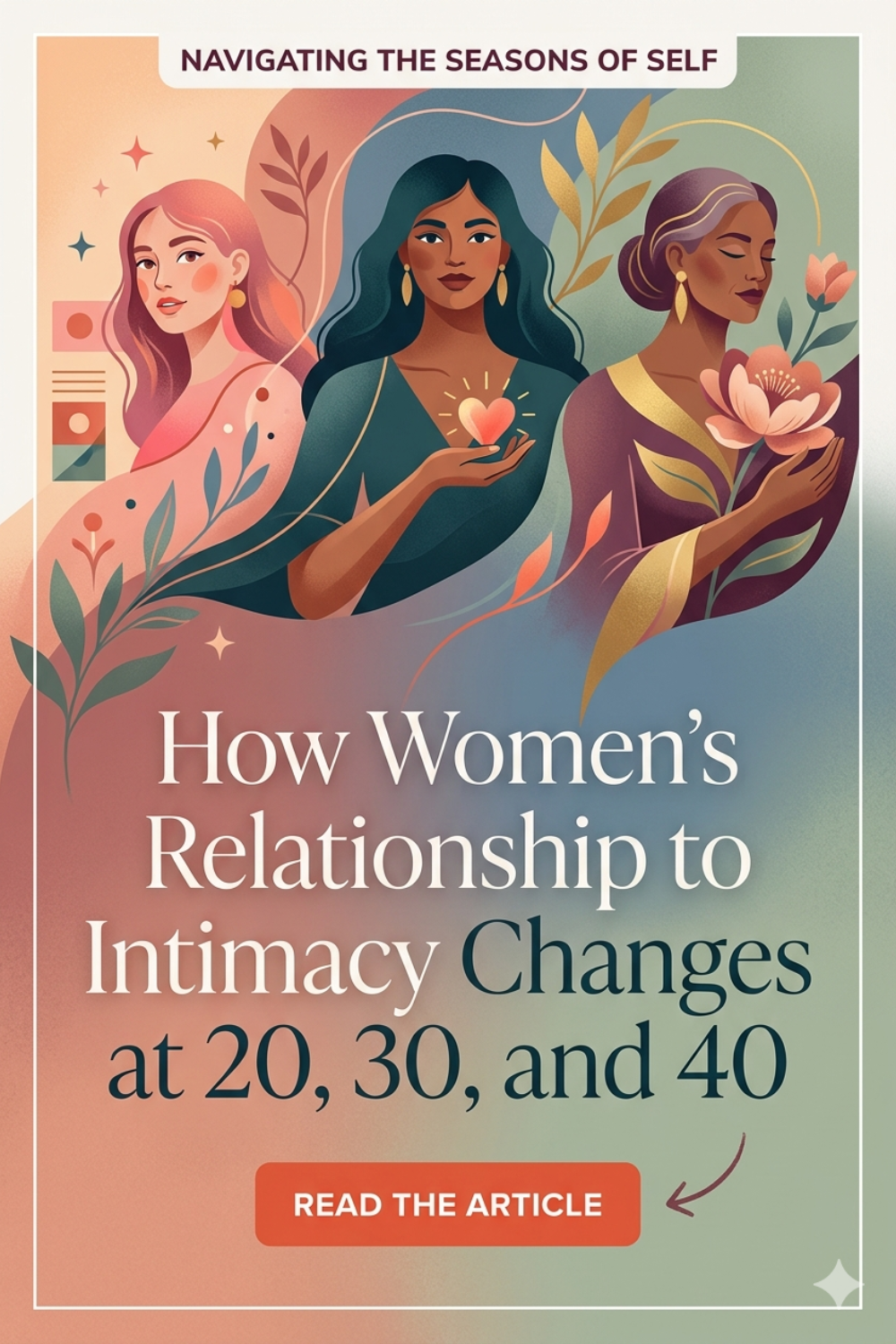

Intimacy — emotional and physical closeness with another person — isn’t static across a lifetime. The way a woman experiences desire, vulnerability, self-worth, and connection in her 20s often looks nothing like how she experiences those same things in her 30s or 40s. This isn’t really about biology alone. It’s about something more interesting: the slow accumulation of self-knowledge, the gradual untangling from old patterns, and the steady process of learning what we actually want versus what we were taught to seek.
This isn’t a universal timeline — plenty of women feel deeply secure at 22, and plenty of women are still untangling old patterns at 45. But there are real, well-documented psychological patterns that tend to shift with age and experience, and understanding them can be genuinely clarifying, wherever you currently find yourself.
The 20s: Searching for Validation Through Connection
In our 20s, many of us are still actively forming our sense of identity — psychologists sometimes call this “identity consolidation,” and it continues well into the mid-to-late twenties for most people. This means a lot of our choices, including relationship choices, are happening before we’ve fully figured out who we are independent of other people’s reactions to us.
For many women, this stage involves seeking external confirmation of their own worth and attractiveness through romantic and intimate connection. If self-esteem hasn’t yet been firmly established — sometimes because of inconsistent attention or validation in childhood — intimacy can become tangled up with something deeper than physical connection: a search for proof that we are lovable, wanted, and enough.
This isn’t a character flaw. It’s a well-documented developmental pattern. Attachment research consistently shows that the quality of our earliest relationships — particularly with primary caregivers — shapes the templates we bring into adult romantic relationships, often without our conscious awareness. A woman who experienced inconsistent attention or emotional unavailability from a parent may, without realizing it, seek out relationships that recreate that same dynamic, chasing a sense of being truly seen that she didn’t reliably receive earlier in life.
The result, for many women in their 20s, is a relationship to intimacy and dating that swings between extremes — sometimes pursuing connection urgently, sometimes pulling back defensively, often without a clear sense of what they actually want versus what they think they’re supposed to want. This is genuinely difficult terrain to navigate, and it’s worth extending yourself real compassion if this describes your own 20s, rather than judgment.
The 30s: Learning to Advocate for Yourself
Something shifts for many women by their 30s, and it’s not really about declining options or a ticking clock — it’s about accumulated self-knowledge. By this stage, many women have enough relationship experience to recognize patterns: which kinds of partners and dynamics tend to leave them feeling good, and which tend to leave them feeling diminished.
This often shows up as a meaningful increase in selectivity and self-advocacy. Many women in their 30s describe feeling, for the first time, genuinely comfortable saying no to situations or people that don’t feel right — not from a place of fear or scarcity, but from a place of growing self-respect. Research on self-esteem development across adulthood supports this pattern: self-esteem tends to increase gradually from young adulthood through midlife for most people, partly because of accumulated competence and partly because of a clearer, more stable sense of identity.
This is also frequently the decade where women begin to separate sex and intimacy from external validation. Rather than using connection to answer the question “am I enough?”, many women start approaching intimacy from a place of already knowing the answer — engaging with partners because they genuinely want to, not because they’re seeking proof of their own worth.
Importantly, this is also often a significant period of psychological separation from family-of-origin dynamics. Many women in their 30s describe consciously stepping back from old patterns of guilt or obligation inherited from their families, and beginning to make life and relationship decisions based on their own values rather than inherited expectations. Family systems therapists often describe this as a healthy and important developmental task — distinguishing your own desires from the ones you absorbed growing up.
The 40s and Beyond: Clarity, Confidence, and Genuine Choice
By the 40s, many women describe a kind of intimacy and relationship clarity that simply wasn’t available to them earlier — not because of any single dramatic realization, but because of decades of accumulated self-understanding. Research on midlife psychological development consistently finds that self-acceptance and emotional regulation tend to improve significantly through this period, even as other aspects of life (career, family responsibilities) often grow more complex.
This frequently translates into a markedly different relationship to both intimacy and self-worth. Many women in their 40s describe feeling less interested in relationships or encounters that don’t feel genuinely reciprocal, and more confident in recognizing — often quickly — when a connection isn’t serving them. The patience for ambiguous, low-investment, or emotionally unavailable partners that may have characterized earlier decades often diminishes substantially.
This isn’t about settling for less excitement or adventure — many women report their 40s as a genuinely vibrant period for both emotional and physical intimacy, often because they’re finally approaching it from a place of security rather than need. The difference is the foundation: connection sought from wholeness rather than from a search for completion.
It’s worth saying clearly: this isn’t a universal experience, and there’s no “correct” timeline for reaching this kind of clarity. Plenty of women arrive at this place of security earlier; some take longer; the process isn’t linear for anyone, and difficult life events can disrupt and reshape it at any age.
What Actually Drives These Shifts
Several real psychological factors explain why these patterns tend to emerge over time, rather than being simply a function of age itself:
Accumulated self-knowledge. Each relationship, regardless of outcome, provides information about what genuinely works for you. Over time, this builds into a clearer internal compass.
Reduced dependence on external validation. As other areas of life — career, friendships, personal accomplishments — provide stable sources of self-worth, intimacy and relationships often become less burdened with the job of proving our value.
Greater comfort with direct communication. Many women report becoming significantly more comfortable, with age and practice, expressing their needs and boundaries directly rather than hoping a partner will intuit them — a shift strongly associated with relationship satisfaction in research on long-term partnerships.
Healing from earlier relational patterns. For women who recognize unhealthy patterns rooted in family-of-origin dynamics, therapy and conscious self-reflection can meaningfully accelerate the process of developing healthier relational templates, regardless of age.
If You Recognize Earlier Patterns in Yourself Right Now
If you’re in your 20s and recognize some of the patterns described here — seeking validation through connection, difficulty distinguishing what you want from what you think you should want — please know this isn’t a flaw to be ashamed of. It’s an extremely common developmental stage, and self-awareness about it is itself a meaningful step toward change.
A few things genuinely help accelerate healthier patterns at any age:
- Therapy, particularly approaches focused on attachment patterns, can help identify and shift relational templates formed early in life.
- Building self-worth outside of relationships— through accomplishments, friendships, and personal interests — reduces the pressure on romantic connection to carry your entire sense of value.
- Practicing direct communication, even when uncomfortable, builds the self-advocacy skills that tend to develop more naturally with age.
- Extending yourself genuine compassionrather than judgment for past patterns, recognizing that they often developed for understandable reasons rooted in your own history.
The Real Throughline
What changes most across these decades isn’t really about physical intimacy at all — it’s about self-worth, and where we look for evidence of it. In our 20s, many of us are still searching for that evidence externally. With time, self-knowledge, and often real emotional work, many women shift toward finding that evidence internally — which paradoxically tends to make their relationships, intimate and otherwise, considerably healthier and more genuinely satisfying.
Wherever you currently are in this process, the goal isn’t to rush toward some idealized endpoint. It’s simply to keep growing in self-understanding — because that, more than any age milestone, is what actually changes how we experience connection with another person.