
At some point in life, most of us fall for someone we simply can’t have. Maybe the timing is wrong. Maybe they’re unavailable, or already committed elsewhere. Maybe circumstances — distance, life paths, unspoken boundaries — make it clear that this connection, however real it feels, was never going to become what you hoped for.
This isn’t about a passing crush. It’s about a person who genuinely touched something in you — and the particular kind of ache that comes from caring deeply about someone you know you can’t be with. That ache can be surprisingly hard to shake, often harder than getting over an actual breakup, because there was no real relationship to officially end. Just feelings, unresolved, with nowhere to go.
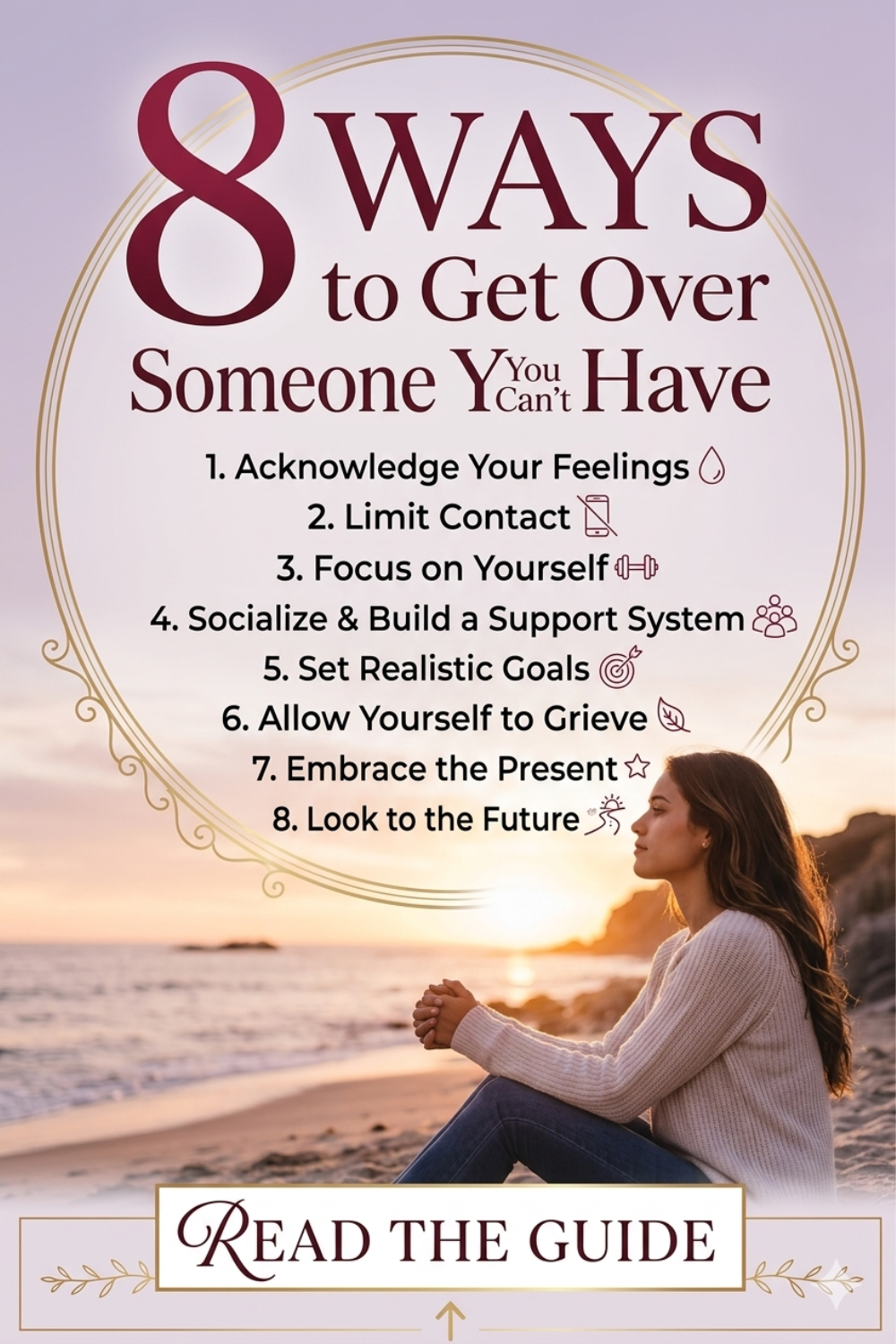
If you’re in that place right now, here are 8 real ways to get over someone you can’t have — grounded in genuine emotional understanding, not just generic distraction tactics.
1. Let Yourself Feel It Instead of Rushing Past It
The instinct when something hurts is often to push past it as quickly as possible — stay busy, distract yourself, pretend you’re fine. But unprocessed feelings rarely disappear; they tend to resurface later, often at less convenient moments.
What you’re feeling right now — disappointment, grief, longing, maybe even a little embarrassment — is a completely normal response to genuine emotional investment. You cared about someone, and that connection didn’t get to become what you hoped. That’s worth grieving, not minimizing.
Give yourself real permission to feel this without rushing toward “being over it.” Healing happens through the difficult feelings, not around them. The version of you who fully processes this will move on more solidly than the version who just suppresses it and hopes it goes away.
2. Create Distance from the Reminders
If you’ve been holding onto photos, old messages, songs that remind you of them, or anything else that keeps the connection emotionally present, it’s worth setting those things aside for a while — not necessarily forever, but for now.
This isn’t about bitterness or pretending the connection didn’t matter. It’s about giving your mind room to recalibrate without constant emotional triggers pulling you back into longing. The same logic applies to places you associate strongly with them, or — if it’s relevant to your situation — limiting how much you check their social media.
Out of sight isn’t a permanent strategy, but it’s an effective short-term one. You can’t fully heal from something you’re actively re-experiencing every day.
3. Lean Into the People Who Already Love You
It’s easy, when you’re stuck on someone you can’t have, to feel like your emotional world has narrowed down to just them. But the truth is, you’re very likely surrounded by people — friends, family, even close colleagues — who care about you deeply and would be glad to show up for you right now.
Spending time with people who value you does two important things: it reminds you, on a felt level, that you’re not lacking connection in your life — you’re navigating one specific situation that didn’t work out. And it gives you the kind of grounded, reciprocal companionship that helps put unrequited longing into healthier perspective.
You don’t need to explain everything or process out loud constantly. Sometimes just being around people who genuinely care is enough to start shifting how you feel.
4. Use Your Newfound Space Intentionally
There’s likely a particular kind of mental and emotional space that’s opened up now that this connection isn’t progressing the way you’d hoped. It’s tempting to experience that space as just absence — a void where something used to be. But it can also become something more useful: room.
Room to rediscover what you actually want, separate from the dynamic you were hoping to build with someone else. Room to redecorate your living space, pick up something new, or simply structure your time in a way that reflects your own preferences rather than the rhythms of someone else’s availability.
This isn’t about forcing positivity onto something painful. It’s about recognizing that unstructured time, while uncomfortable at first, is also genuinely yours to use.
5. Redirect Energy Toward Things You’ve Been Putting Off
Unrequited longing has a way of consuming far more mental bandwidth than we realize — replaying conversations, imagining different outcomes, wondering “what if.” Redirecting some of that energy toward concrete goals can be remarkably effective, not as distraction, but as genuine reinvestment in your own life.
Is there a skill you’ve wanted to learn? A class you’ve been meaning to take? A goal you’ve quietly postponed while your attention was elsewhere? Now is a reasonable time to revisit it.
This works because it does something passive distraction can’t: it gives you evidence, over time, that your life is moving forward and expanding — not just enduring until the ache fades.
6. Write It Out
Putting your feelings into words — through journaling, an unsent letter, or simply private reflection — can be a remarkably effective way to process emotions that otherwise just circle endlessly in your head.
There’s something clarifying about seeing your own thoughts on paper. Patterns become visible. The intensity of a feeling on a hard day looks different a week later when you reread it. And over time, journaling creates a kind of personal record of your healing — proof, in your own words, that the acute pain of today is not where you’ll permanently stay.
You don’t need to be a “writer” for this to work. The goal isn’t polished prose. It’s honest processing.
7. Take Care of Your Body, Not Just Your Heart
Emotional pain and physical wellbeing are more connected than people often realize. Regular movement, reasonably consistent sleep, and basic nourishment all play a meaningful role in emotional regulation — not as a cure, but as genuine support during a hard stretch.
Exercise in particular has well-documented effects on mood, largely through its impact on stress hormones and neurotransmitters associated with emotional regulation. You don’t need an intense routine — a daily walk, some movement you enjoy, anything that gets you out of your head and into your body can help meaningfully.
This is one of those pieces of advice that sounds almost too simple to matter, but the research backing it is genuinely strong. Taking care of your physical self is taking care of your capacity to heal emotionally.
8. Find a Source of Meaning Beyond the Situation
Whether that’s spiritual practice, a value system you hold, a community you’re part of, or simply your own reflective sense of what matters to you — having something larger than the immediate pain to anchor yourself to can make a real difference in how manageable this period feels.
For some people, this looks like prayer or religious practice. For others, it’s a meditation practice, time in nature, creative expression, or simply conversations with people whose perspective they trust. The specific form matters less than the function: giving yourself access to a broader frame than “this one person, this one situation, this one disappointment.”
That broader frame tends to make the immediate pain feel less all-consuming — not because the situation doesn’t matter, but because you’re reminded that your life holds more than this one chapter.
A Note on Timing
It’s worth saying clearly: there’s no fixed timeline for getting over someone you can’t have. Some people move through it in weeks; for others, especially when the connection ran deep, it can take significantly longer. Neither pace is wrong.
What matters more than speed is direction. Are you, even slowly, moving toward more good days than hard ones? Are the waves of longing becoming less frequent and less intense over time, even if they haven’t disappeared entirely? That kind of gradual progress, even when it doesn’t feel dramatic, is exactly what healing looks like in practice.
Final Thoughts
Getting over someone you can’t have is genuinely difficult — there’s no version of this process that skips the hard parts. But it is also survivable, and more than that, it’s often the beginning of real growth: a clearer sense of what you want, what you’re capable of feeling deeply, and what kind of connection you’re actually looking for going forward.
This isn’t the end of your story. It’s one chapter — a hard one, but not a permanent one. The right connection, when it comes, will find you better equipped to recognize and receive it, precisely because of what this experience taught you about your own capacity to love fully.