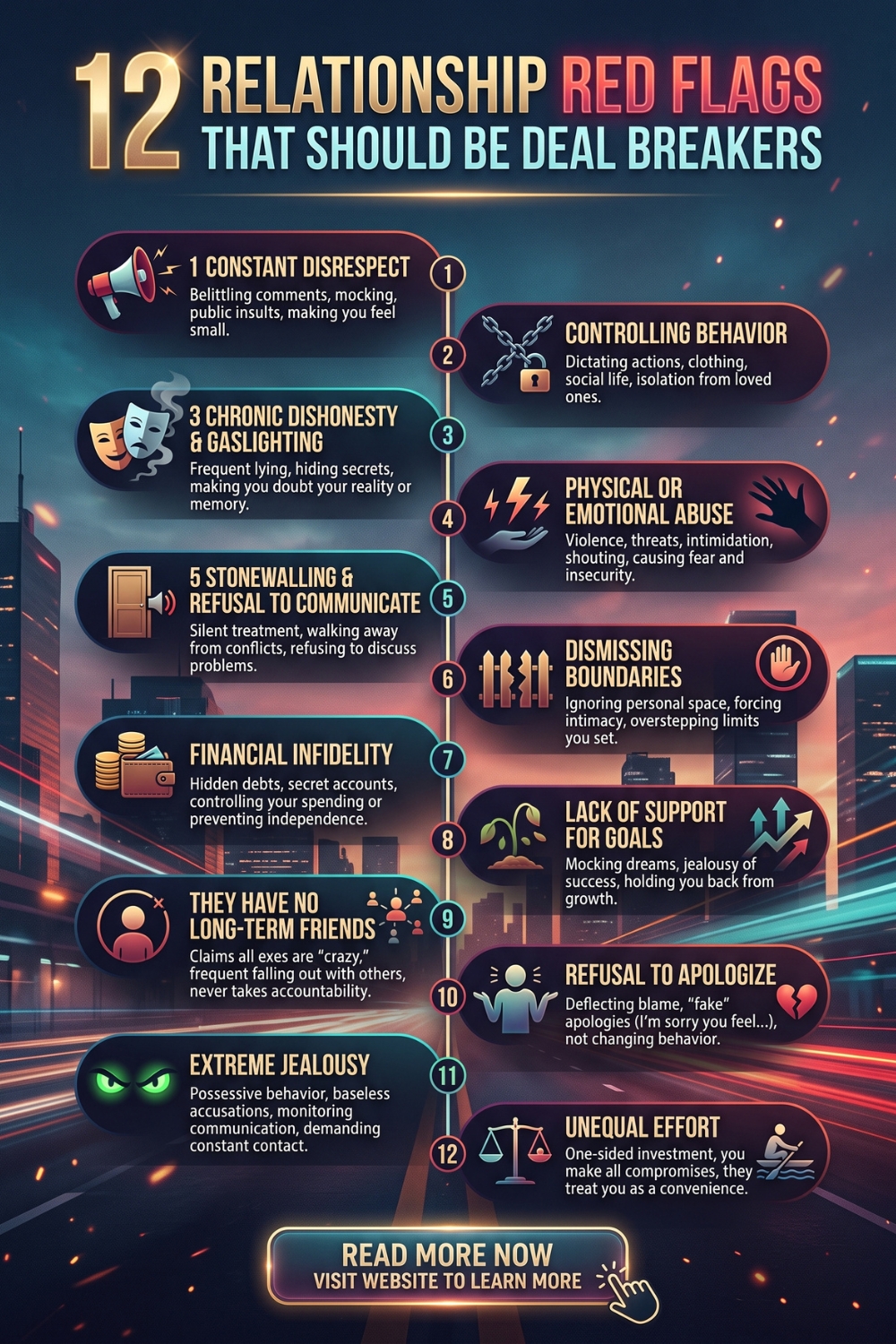

We’ve all heard the saying that love is blind. When you’re falling for someone, the rush of new romance can easily put rose-colored glasses over your eyes. Suddenly, those quirky little habits seem endearing, and you might find yourself making excuses for behavior that your friends and family are raising their eyebrows at.
But navigating the dating world requires a balance of an open heart and a sharp mind. While compromise is a normal part of any partnership, there is a massive difference between normal human flaws and toxic traits. Knowing how to tell the difference is the foundation of good relationship advice.
If you want to achieve long-term relationship goals, you need to know when to walk away. In this comprehensive guide, we are diving deep into the 12 relationship red flags that should be absolute deal breakers. Whether you are casually dating or evaluating a long-term commitment, these relationship tips will help you protect your peace, set healthy boundaries, and ensure you are building a life with someone who truly respects you.
Quick Answer: What is a relationship red flag?
A relationship red flag is a warning sign indicating unhealthy, toxic, or manipulative behavior in a partner. These behaviors often point to deeper character flaws or psychological issues that can lead to emotional abuse, lack of trust, and the eventual breakdown of the relationship. Identifying red flags early is crucial for maintaining your emotional well-being.
What Exactly Are Relationship Red Flags vs. Yellow Flags?
Before we dive into the specific deal breakers, it’s important to distinguish between red flags and yellow flags. Exceptional love advice always leaves room for human error, but it draws a hard line at abuse and manipulation.
Yellow flags are cautious warning signs. They are behaviors that might need addressing but aren’t immediate grounds for a breakup. For example, a partner who is slightly messy, has a different communication style, or occasionally gets defensive during arguments is waving a yellow flag. With mutual effort, therapy, and good relationship tips, yellow flags can often be resolved.
Red flags, on the other hand, are non-negotiable. They are patterns of behavior that showcase a fundamental lack of respect, empathy, or safety. They tell you that the foundation of the connection is fractured.
Let’s break down the 12 most critical red flags you should never ignore.
12 Non-Negotiable Relationship Red Flags
1. Constant Disrespect and Belittling
Healthy relationships are built on a foundation of mutual respect. If your partner regularly belittles you, makes you the butt of their jokes, or speaks down to you, this is a massive red flag.
What it looks like:
-
Mocking your career, hobbies, or intelligence.
-
Using “sarcasm” as a disguise for mean-spirited insults.
-
Rolling their eyes when you express an opinion.
Disrespect chips away at your self-esteem over time. True love goals involve finding a partner who is your biggest cheerleader, not your harshest critic. If you find yourself constantly feeling small or foolish around your partner, it is time to reevaluate the relationship.
2. Controlling Behavior and Isolation
A partner who wants to know your whereabouts 24/7 isn’t showing you how much they care; they are showing you how much they want to control you. Control often starts small and escalates over time.
What it looks like:
-
Dictating what you wear or how you style your hair.
-
Demanding your phone passwords or tracking your location.
-
Guilt-tripping you for spending time with friends or family.
Isolation is a classic tactic used by toxic partners to remove your support system. When you are cut off from your loved ones, you become entirely dependent on your partner, making it much harder to leave. Good relationship advice always emphasizes maintaining your independence and outside friendships.
3. Chronic Dishonesty and Gaslighting
Trust is the currency of any romantic partnership. If your partner has a habit of lying—even about small, seemingly insignificant things—you will never feel secure.
What it looks like:
-
Hiding financial transactions or secret social media accounts.
-
Lying about who they were with or where they were.
-
Gaslighting: A psychological manipulation tactic where they make you question your own memory, perception, or sanity. (e.g., “I never said that, you’re just acting crazy.”)
If you constantly feel the need to play detective in your own relationship, that alone is a deal breaker. You deserve a partner whose words match their actions.
4. Physical, Emotional, or Verbal Abuse
This is the most critical deal breaker on the list. Abuse in any form—whether it leaves a physical bruise or an emotional scar—is completely unacceptable.
What it looks like:
-
Physical: Grabbing, pushing, hitting, or blocking you from leaving a room.
-
Emotional: Threatening self-harm to manipulate you, giving you the silent treatment for days, or threatening to ruin your reputation.
-
Verbal: Screaming, name-calling, or using aggressive, intimidating language.
Note: If you are experiencing abuse, please reach out to the National Domestic Violence Hotline or a local support organization. Your safety is paramount.
5. Stonewalling and Refusal to Communicate
Conflict is inevitable. Two people bringing different backgrounds and perspectives into a shared life will naturally disagree. However, the measure of a healthy relationship is how you navigate those disagreements.
What it looks like:
-
Walking away mid-conversation without a promise to return and finish it.
-
Shutting down entirely and refusing to speak for days (the silent treatment).
-
Saying things like, “I’m not talking about this anymore,” whenever a valid issue is raised.
Stonewalling makes conflict resolution impossible. It leaves one partner holding all the emotional weight of the relationship. For a partnership to thrive, both parties must be willing to sit in the discomfort of tough conversations.
6. Dismissing Your Boundaries
Boundaries are the invisible lines we draw around ourselves to protect our mental, emotional, and physical well-being. A partner who loves you will respect those lines. A toxic partner will treat them as obstacles to overcome.
What it looks like:
-
Pushing you for physical intimacy when you have said no.
-
Showing up unannounced at your workplace after you asked them not to.
-
Continuing a behavior after you have explicitly stated that it hurts you.
When someone ignores your boundaries, they are communicating that their immediate desires are more important than your long-term comfort and safety.
7. Financial Infidelity and Control
Money is one of the leading causes of divorce and breakups. While couples can have different spending habits, financial manipulation is a major red flag.
What it looks like:
-
Racking up massive, secret debts.
-
Refusing to let you have access to joint bank accounts.
-
Controlling your income or preventing you from working so you remain financially dependent.
Financial abuse traps people in toxic relationships. Real relationship goals involve financial transparency and teamwork, where both partners feel secure and informed about their shared future.
8. Lack of Support for Your Goals
A healthy relationship should act as a launchpad, not an anchor. Your partner doesn’t have to share your exact dreams, but they should absolutely support your pursuit of them.
What it looks like:
-
Mocking your decision to go back to school or change careers.
-
Becoming jealous or competitive when you achieve success.
-
Complaining about the time you dedicate to your personal passions.
As the famous love quotes often remind us, true love is wanting the best for the other person. If your partner is intimidated by your growth, they will eventually try to stunt it.
9. They Have No Long-Term Friends
While it’s true that some people are naturally introverted, an inability to maintain long-term friendships or professional relationships can be a glaring red flag.
What it looks like:
-
They claim all their exes were “crazy.”
-
They frequently fall out with friends, family members, or coworkers.
-
They refuse to take accountability for any of these severed ties, always playing the victim.
How a person treats others—and how they handle conflict outside of your romantic bubble—is a massive indicator of their true character. If they are the common denominator in a dozen failed, toxic relationships, it’s only a matter of time before you become the next “crazy ex.”
10. Refusal to Apologize or Change
We all make mistakes. But the hallmark of emotional maturity is the ability to say, “I was wrong, I am sorry, and here is how I will fix it.”
What it looks like:
-
Offering fake apologies: “I’m sorry you feel that way.”
-
Turning the blame back on you: “I wouldn’t have yelled if you hadn’t annoyed me.”
-
Promising to change but never actually adjusting their behavior.
An apology without changed behavior is just manipulation. You cannot build a healthy future with someone who is allergic to accountability.
11. Extreme Jealousy and Insecurity
While a tiny pang of jealousy is a normal human emotion, weaponized insecurity is dangerous. Extreme jealousy is not a sign of deep love; it is a sign of deep possessiveness.
What it looks like:
-
Accusing you of flirting with the waiter, a coworker, or a friend.
-
Demanding that you cut ties with friends of the opposite sex.
-
Blowing up your phone with texts and calls if you don’t respond within five minutes.
This behavior is exhausting and creates an environment where you are constantly walking on eggshells, trying to preemptively soothe their irrational fears.
12. Unequal Effort and One-Sided Love
Relationships require a 50/50 split of effort over the long haul (though it might occasionally fluctuate to 70/30 during hard times). But if you are always the one driving the connection, you are dealing with a red flag.
What it looks like:
-
You are always the one initiating dates, texts, and physical affection.
-
You make all the sacrifices and compromises.
-
They treat your relationship like a convenience rather than a priority.
You cannot love someone enough to make them love you back the way you deserve. Settling for crumbs of affection is a direct violation of healthy relationship goals.
How to Navigate Red Flags When You Spot Them
Seeing a red flag in someone you care deeply about is painful. It’s natural to want to look the other way. However, the best relationship advice dictates that you must address these issues head-on.
1. Trust Your Intuition
If something feels off, it usually is. Don’t let your partner gaslight you into thinking you are overreacting. Your emotional responses are valid data points.
2. Communicate Clearly
If you spot a behavior that crosses a boundary, communicate it immediately. Use “I” statements. (e.g., “I feel disrespected when you speak to me in a sarcastic tone in front of our friends.”) Watch how they react. A healthy partner will listen and apologize. A toxic partner will double down, get defensive, or blame you.
3. Seek Outside Perspective
Toxic relationships thrive in secrecy. Talk to a trusted friend, family member, or a licensed therapist. Getting an objective third-party opinion can help pull you out of the confusion and validate your experiences.
4. Be Prepared to Walk Away
Setting a boundary is useless if you do not enforce the consequence. If a partner repeatedly violates your boundaries and displays these non-negotiable red flags, you have to be willing to leave. Remember, being single is infinitely better than being trapped in a toxic relationship.
Setting Healthy Relationship Goals Instead
Now that we have covered the deal breakers, let’s briefly look at the “green flags” you should be aiming for. Healthy relationship goals include:
-
Active Listening: A partner who hears you out, validates your feelings, and remembers the details of your life.
-
Emotional Safety: Feeling completely comfortable being your authentic, unguarded self without fear of judgment or retaliation.
-
Shared Humor and Joy: A relationship shouldn’t feel like constant work. There should be abundant laughter, playfulness, and friendship at its core.
-
Mutual Growth: You both encourage each other to evolve, learn, and succeed.
Keep these love tips in your back pocket when dating. When you know what a healthy dynamic looks like, the toxic ones become much easier to spot and discard.
Frequently Asked Questions About Relationship Advice
What should I do if my partner has just one red flag?
It depends on the severity of the red flag. If it is physical or severe emotional abuse, even one red flag is a strict deal breaker. If it is something like poor communication during arguments, you can attempt to address it through open dialogue or couples counseling. However, if they refuse to work on it, that single red flag becomes a reason to leave.
Can a toxic person change?
People can change, but only if they recognize their toxic traits, take full accountability, and actively seek professional help (like therapy). They have to want to change for themselves, not just to keep you from leaving. You cannot “fix” a toxic partner with enough love or patience.
How do I leave a relationship with lots of red flags?
Safety first. If your partner is controlling or abusive, do not break up with them in private. Confide in friends, family, or a domestic abuse hotline to create a safe exit plan. Secure your finances, find a safe place to stay, and consider cutting off contact entirely to prevent them from manipulating you into staying.
Why do I keep attracting partners with red flags?
Often, we accept the love we think we deserve. If you grew up in an environment where chaos, inconsistency, or emotional distance was normal, your brain might unconsciously seek out those familiar patterns in adulthood. Working with a therapist to uncover these underlying attachment styles is the best relationship advice for breaking the cycle.
Conclusion: Protect Your Peace and Never Settle
Navigating love and romance is one of life’s greatest adventures, but it shouldn’t come at the cost of your self-esteem, safety, or happiness. Recognizing these 12 relationship red flags is the first step in advocating for yourself.
Remember, healthy relationship goals are not just about curated Instagram photos or cute love quotes; they are about finding a true teammate. You deserve a relationship built on unshakeable trust, mutual respect, and genuine emotional safety.
If you are currently looking at your partner and seeing a field of red flags, it is time to trust your gut and choose yourself. Never apologize for having high standards—the right person will rise to meet them.