
You didn’t see it coming. That’s the thing about narcissistic abuse — it rarely announces itself. It arrives disguised as the most intoxicating love you’ve ever known, wrapped in compliments that feel too perfect, attention that feels like destiny, and a connection so electric it doesn’t seem real.
Because it isn’t.
Narcissistic abuse is one of the most psychologically devastating forms of emotional mistreatment a person can experience — not because it’s always loud or physical, but because it operates in the shadows of your own mind. It rewires how you see yourself. It makes you question your memory, your worth, and your right to feel hurt at all.
If you’ve ever found yourself walking on eggshells around someone you love, apologizing for things that weren’t your fault, or feeling somehow smaller after every interaction with a person who claims to adore you — this article is for you.
Whether you’re in the thick of it, trying to make sense of the past, or simply wanting to recognize the warning signs before you get hurt, understanding the core behaviors of narcissism is one of the most empowering things you can do. Because once you can name what’s happening, you can start to reclaim yourself.
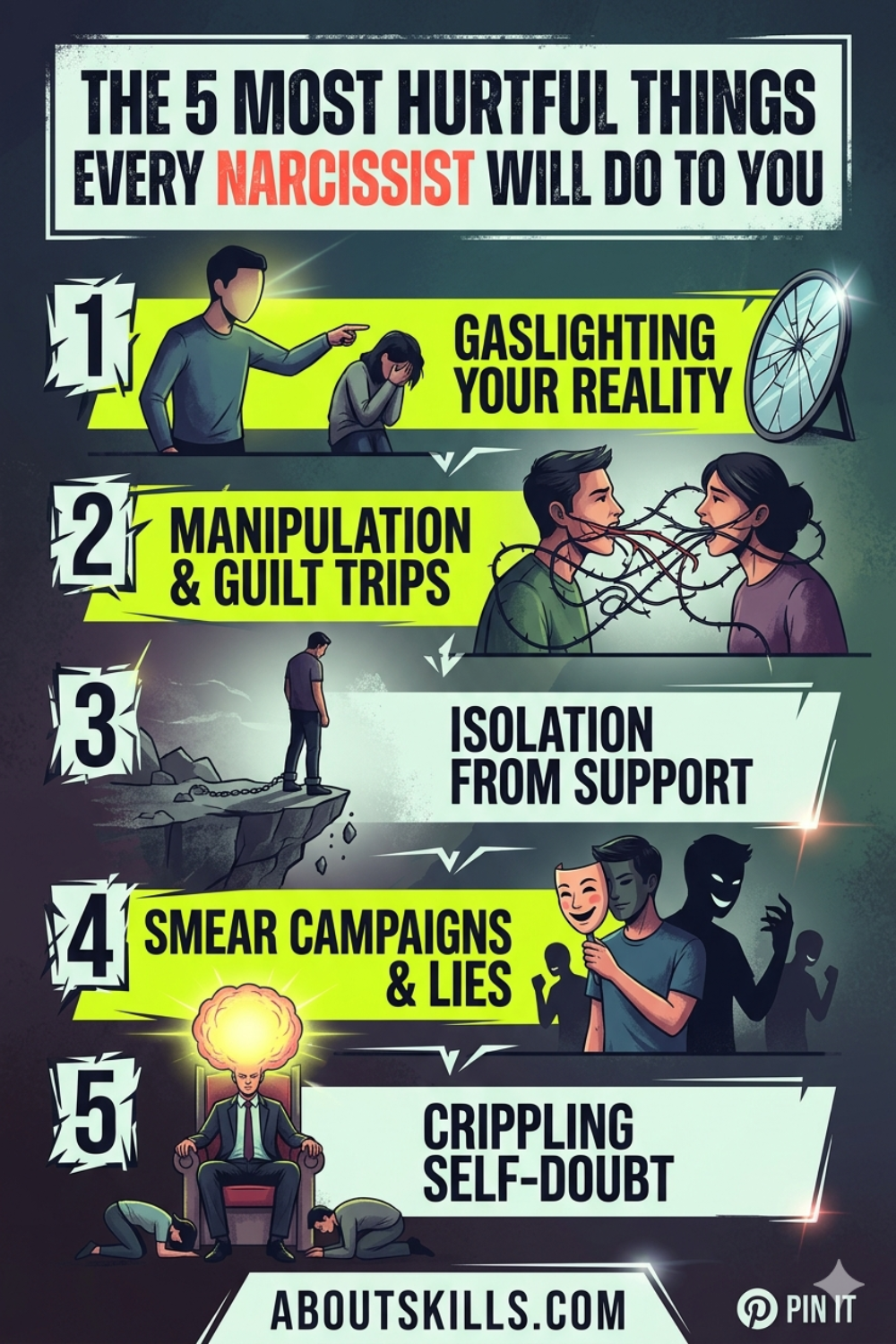
Here are the five most hurtful — and most universal — things every narcissist will do to you.
1. They Will Love Bomb You — Then Take It All Away
Of all the things a narcissist does, this may be the most insidiously cruel: they show you exactly what it would feel like to be truly cherished, and then they use that feeling against you.
Love bombing is the term psychologists use to describe the overwhelming flood of affection, attention, flattery, and intensity that narcissists deploy in the early stages of a relationship. They text constantly. They call you their soulmate within weeks. They make grand romantic gestures, remember every detail about you, and make you feel like the most extraordinary person they’ve ever encountered.
It feels like the relationship you’ve always dreamed of. And that’s exactly the point.
Why Love Bombing Is So Effective
According to clinical psychologists, love bombing works because it exploits our most basic human needs — the need to be seen, valued, and loved. The narcissist studies you during this phase, cataloguing your desires, your wounds, and your deepest longings. Then they become the person who fulfills every one of them — not because they feel it, but because it binds you to them.
Research published in the Personality and Social Psychology Bulletin confirms that narcissists show low long-term relationship commitment because they are perpetually scanning for the next, better source of validation. Love bombing is not about you — it’s about securing their supply.
Then comes the shift.
Once the narcissist feels your emotional attachment is secured, the warmth begins to ebb. The compliments get replaced with subtle criticisms. The attention becomes unpredictable. The person who once treated you like their greatest treasure now treats you like an inconvenience. And because you’ve experienced the high, you’ll spend enormous energy trying to get back to it — which is exactly what they want.
What This Does to You
The love bombing-to-withdrawal cycle creates a powerful trauma bond — a neurochemical addiction to the relationship that mimics the pattern of addiction itself. The intermittent highs flood your brain with dopamine and oxytocin; the lows create a withdrawal-like crash that drives you back to the narcissist in search of the warmth you know they’re capable of giving.
This is not a character flaw on your part. It is a calculated — if not always fully conscious — pattern of psychological manipulation.
Warning signs of love bombing:
- Declarations of deep love or “soulmate” status within weeks of meeting
- Constant communication that feels overwhelming but also addictive
- Grand gestures that seem disproportionate to how long you’ve known each other
- A sense that the relationship is “moving faster than anything I’ve experienced before”
- Feeling as though you owe them your loyalty because of everything they’ve given you
2. They Will Gaslight You Until You No Longer Trust Yourself
If love bombing is the hook, gaslighting is the cage.
Gaslighting is a form of psychological manipulation in which the narcissist systematically distorts your perception of reality — making you doubt your memory, your emotions, and ultimately your own sanity. The term comes from the 1944 film Gaslight, in which a husband manipulates his wife into believing she is losing her mind.
In a relationship with a narcissist, gaslighting can be so gradual and so subtle that you don’t realize it’s happening until you’re already deep inside the confusion it creates.
How Narcissists Gaslight
Gaslighting rarely looks like an obvious lie. It more often sounds like:
- “That never happened. You’re imagining things.”
- “You’re being way too sensitive.”
- “I never said that. You always twist my words.”
- “Everyone thinks you’re overreacting, not just me.”
- “You have a terrible memory — this is a pattern with you.”
Over time, these seemingly small dismissals accumulate into a profound erosion of your self-trust. You begin to defer to the narcissist’s version of events even when your gut tells you something is deeply wrong. You apologize for your feelings. You wonder if maybe you are too emotional, too demanding, too much.
The Psychological Damage of Gaslighting
Clinical therapists consistently identify gaslighting as one of the most psychologically damaging forms of emotional abuse, precisely because it attacks the foundations of a person’s inner world. Victims of long-term gaslighting frequently experience:
- Chronic self-doubt and anxiety
- Difficulty trusting their own perceptions and decisions
- Elevated symptoms of depression and PTSD
- A reflexive need to seek validation from others for even basic judgments
- Confusion about what is “real” in the relationship
It is worth noting that narcissistic gaslighting can also operate through proxies — the narcissist may recruit friends, family members, or colleagues to support their distorted version of reality, deepening your sense of isolation and self-doubt.
If you are experiencing this: Your feelings are real. Your memories are valid. Confusion is not the same as being wrong.
3. They Will Use the Silent Treatment as a Weapon
Few things are more psychologically destabilizing than being deliberately ignored by someone you love. And for narcissists, silence is not a retreat — it is a weapon.
The narcissistic silent treatment is the deliberate withdrawal of communication, acknowledgment, and presence as a means of punishment, control, and manipulation. Unlike a healthy person who might need space to process a difficult conversation, the narcissist’s silent treatment is intentional and targeted. Its purpose is not to regulate their own emotions — it is to regulate yours.
What the Silent Treatment Actually Does
When a narcissist goes silent, a predictable psychological sequence begins in their target:
- Confusion — What did I do? What’s happening?
- Anxiety — Why won’t they respond? Is this over?
- Self-blame — It must have been my fault. I shouldn’t have said that.
- Desperation — I need to fix this. I need them back.
- Capitulation — The victim apologizes, reaches out, or “makes it right” — regardless of whether they were actually at fault.
This is the outcome the narcissist is engineering. The silent treatment teaches you that their approval can be removed at any moment, and that to keep the peace, you must be the one who yields.
According to therapists at Choosing Therapy, the narcissistic silent treatment is used to communicate displeasure, enforce control, and punish perceived slights — and it qualifies as emotional abuse regardless of whether it is loud or dramatic.
The Long-Term Impact
Repeated exposure to the silent treatment can cause lasting psychological harm, including heightened anxiety, hypervigilance to the narcissist’s moods, and a deep-seated fear of abandonment that extends far beyond the relationship itself. Survivors often describe walking on eggshells — constantly monitoring their words and behavior to avoid triggering the next withdrawal.
Recognize this pattern:
- Silence that appears suddenly and without clear explanation
- Communication withdrawal that lasts hours, days, or even weeks
- The silence ending only when you have apologized or submitted
- A recurring sense that you must earn their presence back after minor disagreements
4. They Will Triangulate You to Keep You Insecure
If there is one tactic that captures the specific sadism of narcissistic behavior, it is triangulation — and it is far more common than most people realize.
Triangulation is the deliberate introduction of a third party — real or implied — into the dynamic of your relationship, for the purpose of creating insecurity, jealousy, and competition. The narcissist positions themselves at the apex of a triangle, with you and another person — an ex, a friend, a coworker, a family member — competing for their approval at the base.
How Triangulation Shows Up in Relationships
Triangulation can look many different ways:
- Constantly referencing an ex-partner in flattering terms to make you feel inadequate by comparison
- Mentioning that someone else “really gets” them in a way that implies you don’t
- Using a mutual friend to communicate displeasure rather than speaking to you directly
- Comparing you unfavorably to others in front of people who know you both
- Fostering jealousy by being deliberately vague about their interactions with other people
- Enlisting others to take their side in conflicts, leaving you feeling ganged up on
The intent, in every case, is the same: to keep you in a state of low-grade insecurity that makes you work harder for their approval, compete rather than connect, and remain too destabilized to assert your needs.
Why Narcissists Love Triangulation
At its root, triangulation feeds the narcissist’s fundamental need for narcissistic supply — external validation that temporarily shores up their fragile self-esteem. By keeping multiple people competing for their attention, they secure a steady stream of emotional energy from all directions. As relationship author Diletta Chan notes, the narcissist’s behavior in these situations is “motivated by a sadistic desire for narcissistic supplies” — not genuine affection for any of the parties involved.
It is also worth understanding that triangulation works because it exploits your natural, healthy desire for connection and security. Being compared, sidelined, or made to compete for love is not something you should simply “get over.” It is a form of emotional abuse, and the pain it causes is entirely legitimate.
5. They Will Discard You — And Make You Feel Like It Was Your Fault
The final, and perhaps most devastating, act of a narcissist in a relationship is the discard — the moment when they withdraw or abruptly end the relationship, often with a cruelty that seems incomprehensible given the intimacy you shared.
The discard can happen in different ways. Some narcissists simply vanish — they become cold, withdrawn, and unreachable until the relationship dies of emotional starvation. Others end things explosively, with accusations and cruelty designed to justify their exit. Some begin a new relationship openly, often with someone they’ve been cultivating in the background — a process sometimes called “future faking” — while you are still in the relationship.
Why the Discard Is So Painful
What makes the narcissistic discard uniquely devastating is its structural cruelty. It arrives after the devaluation phase — a period during which the narcissist has systematically eroded your confidence, your sense of reality, and your trust in your own perceptions. By the time the discard comes, many survivors are already questioning their own worth.
The discard then lands as confirmation of every terrible thing the narcissist has implied about you during the devaluation phase — that you were never quite good enough, never quite what they needed, never quite worthy of the version of them that existed during the love bombing phase.
This is not the truth. It is the final manipulation.
As therapists at the Narcissist Test explain, the discard is not a reflection of your value — it is a function of the narcissist’s psychology. They may have found a new source of supply, or the existing relationship may no longer serve their needs as effectively as it once did. The discard is about them, not about anything fundamentally wrong with you.
The Hoovering Trap
Many narcissists do not end the cycle with the discard. Instead, they re-emerge after a period of separation — sometimes weeks, sometimes months, sometimes years — with renewed warmth, apologies, and declarations of change. This phase is called hoovering (after the vacuum brand), and its purpose is to “suck” the victim back into the cycle.
Hoovering is particularly dangerous because it activates the same neurochemical response as the original love bombing — a flood of hope and relief that can override everything the survivor knows about the relationship. And once they return, the cycle — idealization, devaluation, discard — begins again, often with the devaluation arriving faster and more intensely than before.
Are You in a Narcissistic Relationship? Key Questions to Ask Yourself
The following are not a clinical diagnosis, but they are meaningful signs that warrant careful reflection:
- Do you frequently feel confused about what actually happened in arguments?
- Do you find yourself apologizing for things you’re not sure you did wrong?
- Do you feel like you’re always trying to “earn back” affection or approval?
- Has your confidence and self-trust declined significantly since being with this person?
- Do you feel afraid of their reaction when you express a genuine need?
- Do they bring up other people — exes, friends, colleagues — in ways that make you feel inadequate?
- Do they go silent for extended periods as punishment for perceived slights?
- Do they deny saying things you clearly remember them saying?
If several of these resonate with you, you are not overreacting. What you are describing has a name, and support is available.
Healing After Narcissistic Abuse: You Are Not Broken
Surviving a relationship with a narcissist — whether romantic, familial, or professional — leaves real wounds. Complex PTSD, anxiety, depression, and deep difficulties with self-trust are common outcomes of prolonged narcissistic abuse. These are not signs of weakness. They are evidence of what you endured.
Recovery is possible, but it requires more than simply leaving. Healing from narcissistic abuse typically involves:
- Individual therapy with a trauma-informed therapist who understands narcissistic abuse (note: couples counseling with a narcissist is generally not recommended, as it can increase the risk of further manipulation)
- Rebuilding self-trust through small, consistent acts of honoring your own perceptions and boundaries
- Educating yourself about narcissistic patterns so you can recognize them if they appear again
- Connection with others who understand your experience — support groups, trusted friends, and community resources
- Time and self-compassion — recovery from this type of abuse is not linear, and your pace is valid
You are not what they made you feel you were. The confusion, the self-doubt, the sense of unworthiness — these were manufactured. And they can be unmanufactured, one day at a time.
Conclusion: Naming It Is the Beginning of Freedom
Narcissistic abuse thrives in confusion. The love bombing, the gaslighting, the silent treatment, the triangulation, the discard — each of these tactics depends on your inability to clearly see what is happening. The moment you can name the pattern, you begin to step outside of it.
If any part of this article has reflected something you’ve lived through, please know: you are not alone, you are not crazy, and none of it was your fault.
The most hurtful things a narcissist does are not random cruelties — they are a system. And like all systems, once you understand how they work, you hold the power to dismantle their hold on you.