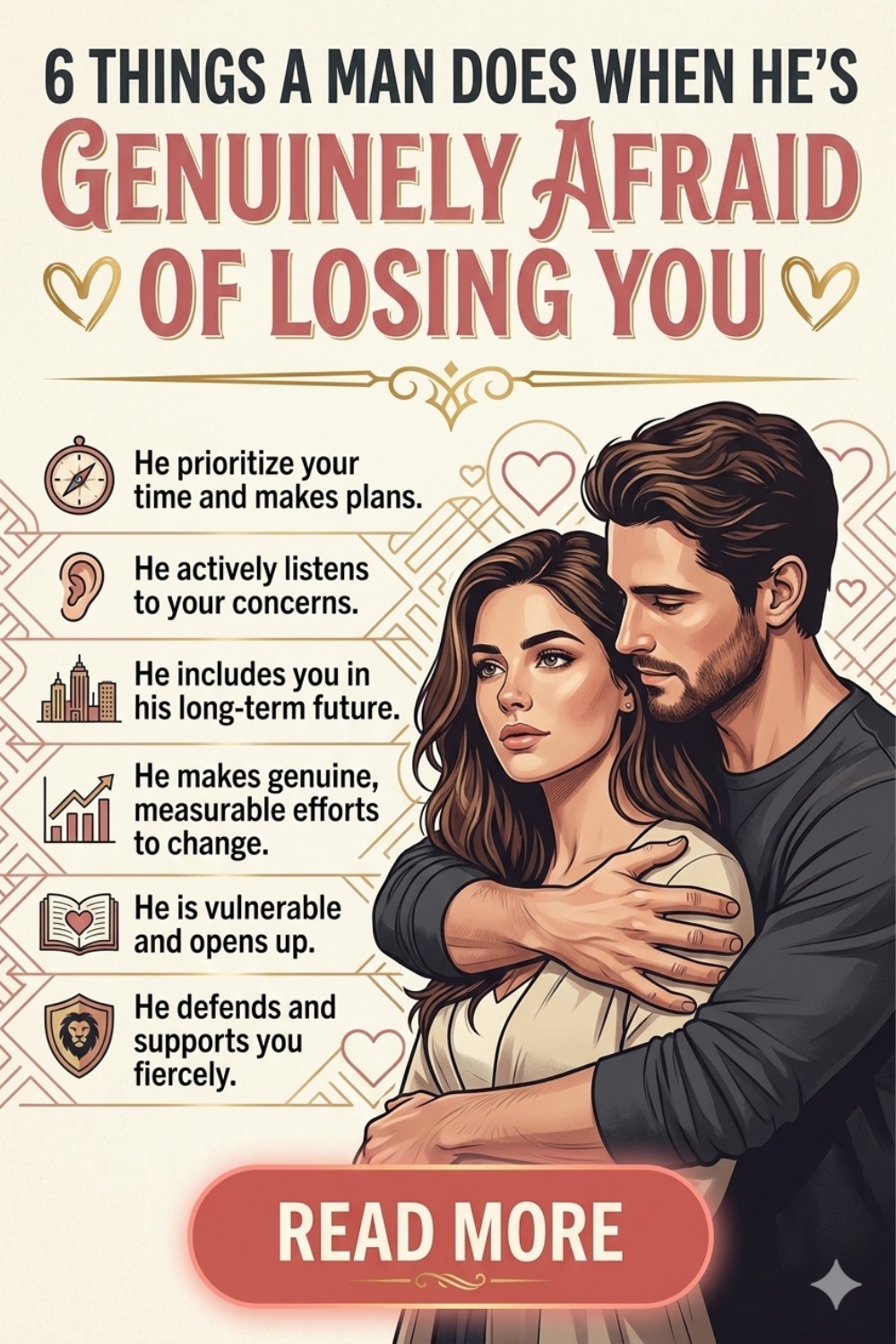

6 Things a Man Does When He’s Genuinely Afraid of Losing You, There’s a particular moment in a relationship when a man who has been coasting suddenly wakes up. Maybe you pulled back. Maybe you stopped chasing the connection and started living your life without waiting on him. Maybe you simply said, out loud, that you weren’t sure this was working anymore.
And then something shifts.
The question worth asking is whether that shift is real. Genuine fear of loss produces real, sustained behavioral change — not a temporary performance designed to win you back before sliding into the same old patterns. Here are six things a man does when his fear of losing you is genuine, along with how to tell the difference between real change and a tactic.
1. He Initiates Instead of Waiting to Be Chased
For a long time, you may have been the one doing the emotional labor — texting first, planning the dates, keeping the connection alive. A man who is genuinely afraid of losing you reverses this pattern, and the reversal is consistent rather than occasional.
He starts reaching out without being prompted. He asks about your day because he wants to know, not because you asked him to be more attentive. He makes plans in advance instead of waiting for you to suggest something. This shift matters because initiation is one of the clearest, most reliable markers of genuine investment — it cannot be faked indefinitely, because it requires ongoing effort rather than a single grand gesture.
The distinction that matters: Genuine change shows up even when nothing is at stake in the moment — on an ordinary Tuesday, not just after a fight. If the initiation only appears during high-tension moments and vanishes once the immediate threat passes, that’s a sign of damage control rather than real change.
2. He Actually Listens to What You’ve Been Saying
Many relationships reach a breaking point only after one person has said, repeatedly, what they needed — and been met with defensiveness, dismissal, or simply nothing. A man who is genuinely afraid of losing you starts actually absorbing what you’ve told him, sometimes for the first time.
This shows up in specific ways: he stops arguing about whether your feelings are valid and starts addressing what’s underneath them. He remembers things you said weeks ago and brings them up unprompted, showing that they actually registered. He asks clarifying questions instead of assuming he already understands.
The distinction that matters: Real listening changes his behavior, not just his words. If he says “I hear you” but nothing about how he treats you actually shifts, the listening was performative — a way to placate you rather than a way to understand you.
3. He Becomes Willing to Talk About the Hard Things
Avoidance is one of the most common ways relationships quietly deteriorate — important conversations get postponed, difficult feelings get smoothed over, and eventually there’s a backlog of unresolved issues that neither person wants to touch. A man who is genuinely afraid of losing you becomes willing to wade into exactly those conversations, even when they’re uncomfortable.
He brings up the thing that’s been bothering him instead of letting it fester. He asks directly where you stand instead of guessing and hoping. He tolerates the discomfort of a hard conversation because the alternative — losing you to unaddressed problems — has become more frightening than the discomfort itself.
The distinction that matters: This willingness should extend beyond the immediate crisis. If he’s only willing to talk about the specific issue that almost ended things, but reverts to avoidance on everything else, the change is narrow and conditional rather than a genuine shift in how he handles conflict.
4. He Stops Taking Your Presence for Granted
There’s a particular quality of attention that returns when someone genuinely fears losing what they have — a noticing that had quietly disappeared somewhere along the way. He starts commenting on things he used to walk past without acknowledgment. He says thank you for things that had become invisible to him. He seems, in small and consistent ways, to be paying attention to you again rather than to the relationship as background noise in his life.
This isn’t about grand romantic gestures. It’s about the return of ordinary noticing — the kind that disappears gradually in long relationships and whose absence is often what makes a partner feel taken for granted in the first place.
The distinction that matters: Watch whether this noticing is specific to you and sustained, or whether it’s generic and short-lived — the kind of attentiveness that shows up for two weeks after a scare and then quietly fades once he believes the danger has passed.
5. He Makes Decisions With You in Mind
When the relationship felt secure to him, he may have made choices unilaterally — plans, decisions, even minor daily choices made without considering how they affected you. A man who is genuinely afraid of losing you starts factoring you into his decision-making in ways that weren’t happening before.
He checks in before making plans that affect you both. He considers your schedule, your needs, your preferences as a default rather than an afterthought. This reflects something deeper than fear alone — it reflects a recognition that the relationship requires partnership, not just his individual choices with you along for the ride.
The distinction that matters: Genuine change here is structural — it becomes how he operates, not a temporary courtesy. If the consideration disappears once he feels reassured that you’re not actually leaving, it was strategic rather than a real adjustment in how he approaches the relationship.
6. He Takes Responsibility Instead of Getting Defensive
Perhaps the most telling sign of genuine fear — and genuine growth — is a shift in how a man responds to being told he did something wrong. Defensiveness is often the default first response to criticism, especially when someone feels caught off guard or threatened. A man who is genuinely afraid of losing you starts catching that defensiveness and choosing accountability instead.
He says “you’re right, I was wrong” instead of immediately explaining why his behavior was justified. He apologizes in a way that names the specific thing he did, rather than offering a vague, deflecting “I’m sorry you feel that way.” This shift requires real humility, and it tends to be one of the hardest changes for anyone to sustain — which is also why it’s one of the most meaningful signs when it’s genuine.
The distinction that matters: Watch for whether accountability becomes a pattern across different situations, or whether it only appears around the specific crisis that triggered his fear. One sincere apology during a moment of panic is not the same as a man who has actually changed how he handles being wrong.
How to Tell Real Change From Temporary Panic
The behaviors above are genuine indicators of a man recognizing what he stands to lose — but they only mean something if they last. Relationship research consistently shows that short-term behavioral spikes following a relationship scare are common and do not, on their own, predict lasting change. What predicts lasting change is consistency over time, particularly once the immediate threat of loss has faded and the relationship feels stable again.
This is the single most important thing to watch for: does the change persist after the fear subsides? A man whose transformation was genuine continues showing up this way weeks and months later, not just during the anxious window when he believed he might actually lose you. A man whose change was driven purely by panic — sometimes referred to as hoovering when it follows a pattern of pulling someone back in only to return to old behavior — will quietly revert once he feels secure again.
Give it time. Watch the pattern, not just the moment. The truth will show itself in what happens after the crisis has passed, when there’s no audience and no immediate stakes — just the daily, ordinary choice of how he treats you.
What This Means For You
If you’re recognizing these signs in your own relationship, it’s worth asking yourself an honest question: was this change something you wanted, or something you needed in order to feel safe staying? Both are valid starting points — but they lead to different places.
If the change is real and sustained, it can be the foundation for a genuinely stronger relationship — one that required a wake-up call to get there, but that arrives somewhere better as a result. If the change is temporary or conditional, the most respectful thing you can do for yourself is to notice that clearly, rather than mistaking a moment of fear for a lasting transformation.
You deserve a relationship where this kind of attentiveness and accountability is simply how things are — not something that only appears when you’re standing at the door.