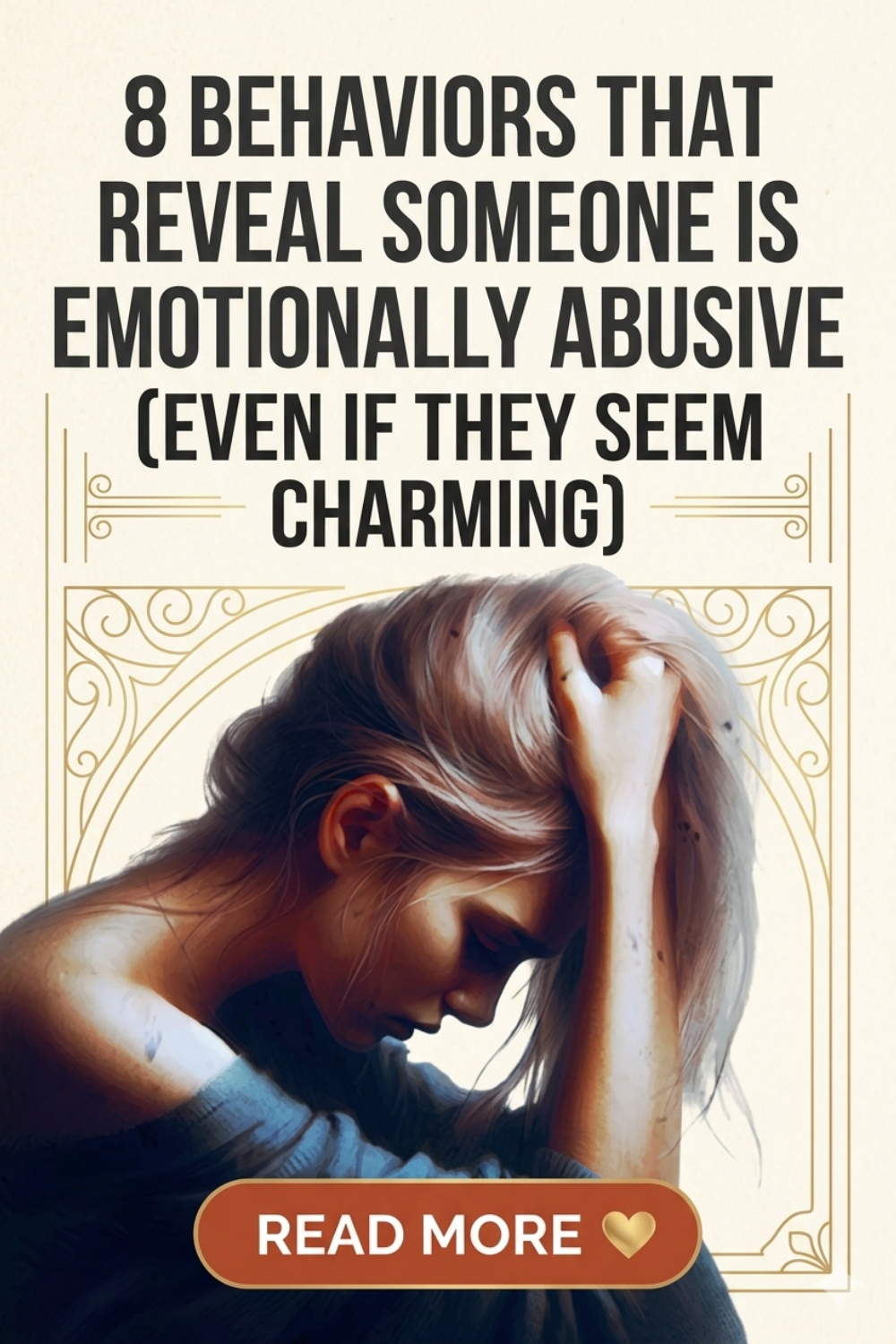

8 Behaviors That Reveal Someone Is Emotionally Abusive — Even If They Seem Charming, Emotional abuse is rarely obvious from the outside. The person causing it is often charming, likable, even widely admired by everyone except the partner who knows what happens behind closed doors. This is not an accident. It is the mechanism.
Abusers do not announce themselves. They build trust first — carefully, convincingly — and only once that trust is established does the real pattern begin to surface: confusing, destabilizing, and very difficult to name while you’re inside it. Most people who experience emotional abuse spend a long time wondering if they’re the problem before they recognize what’s actually happening.
Here are the eight behaviors that reveal emotional abuse — even when the person responsible seems, to everyone else, perfectly fine.
1. Gaslighting
Gaslighting is the deliberate distortion of someone’s perception of reality until they no longer trust their own memory, judgment, or instincts. It rarely looks like an obvious lie. It sounds like: “That never happened.” “You’re remembering it wrong.” “You’re too sensitive.” “Everyone agrees you’re overreacting.”
Over time, repeated gaslighting produces a specific and damaging result: you stop trusting yourself. You begin deferring to the abuser’s version of events even when your gut says something is wrong. Mental health professionals identify this as one of the most psychologically damaging forms of emotional abuse precisely because it attacks the foundation of self-trust that everything else depends on.
What it tells you: If you frequently find yourself apologizing for feelings you’re not sure you should apologize for, or doubting your own memory of events that you were genuinely present for, this is worth taking seriously.
2. The Silent Treatment as Punishment
Healthy people sometimes need space after conflict to process their emotions. Abusers use silence differently — as a deliberate, targeted withdrawal designed to punish and control rather than to self-regulate.
The pattern is predictable: something happens, the abuser goes cold and unreachable, and the silence continues until the other person apologizes, capitulates, or chases reassurance — regardless of who was actually at fault. The silence is not about needing space. It is about teaching you that their attention can be withdrawn at will, and that keeping the peace is your responsibility.
What it tells you: If silence in your relationship reliably ends only when you’ve apologized or given in — even when you weren’t the one who did something wrong — that is not normal conflict resolution. That is control.
3. Constant Criticism Disguised as Help
Emotional abusers rarely criticize directly and obviously at first. The criticism arrives wrapped in concern: “I’m just telling you this because I love you.” “You know I only want what’s best for you.” But the cumulative effect is the same regardless of the packaging — a slow, steady erosion of confidence until the person being criticized starts to believe they genuinely need the abuser’s guidance to function.
This pattern is particularly damaging because it is difficult to argue with on its surface. Each individual comment can sound reasonable. It is only the pattern — the relentless, ongoing stream of “helpful” criticism — that reveals what’s actually happening.
What it tells you: If you feel chronically not-quite-good-enough around someone, and the feedback never seems to stop even when you’ve genuinely tried to improve, the goal may not be improvement. It may be control through diminishment.
4. Isolating You From Other People
One of the clearest markers of emotional abuse is a gradual narrowing of your world. The abuser may not forbid you from seeing friends and family outright — that would be too obvious. Instead, they create friction: making your loved ones seem untrustworthy, picking fights before you see them, or making you feel guilty for spending time with anyone but them.
The goal of isolation is dependency. The fewer outside perspectives you have access to, the more the abuser’s version of reality becomes the only one available to you — and the harder it becomes to recognize that something is wrong.
What it tells you: If your social circle has quietly shrunk since this relationship began, and reconnecting with old friends feels like it requires managing your partner’s reaction first, take note of that pattern.
5. Blame-Shifting and Refusing Accountability
Emotional abusers are remarkably skilled at making every conflict, however it started, end up being your fault. They rarely apologize cleanly. Even when they do something to say sorry for, the apology often arrives with a built-in justification: “I wouldn’t have done that if you hadn’t…”
This pattern protects the abuser from ever having to sit with genuine accountability — and it slowly teaches the other person that conflict is always, somehow, something they caused. Over time, the abused partner often becomes hyper-aware of their own behavior, scanning constantly for what they might have done wrong, while the abuser’s behavior goes largely unexamined.
What it tells you: If you find yourself constantly the one apologizing — even for things that, on reflection, clearly weren’t your fault — pay attention to who in the relationship is actually held accountable.
6. Love Bombing Followed by Withdrawal
Many emotionally abusive relationships begin with an intense, almost overwhelming period of affection — declarations of love early, constant communication, grand gestures that feel like something out of a film. This is love bombing, and its purpose is to create a powerful emotional attachment quickly, before the other person has had time to evaluate the relationship clearly.
Once that attachment is secured, the warmth often begins to recede — replaced gradually by criticism, inconsistency, and emotional withdrawal. The contrast between the initial intensity and the later coldness creates a specific kind of confusion: a desperate desire to return to how things were at the beginning, which keeps people invested long after the relationship has become harmful.
What it tells you: If the relationship’s best moments feel increasingly like memories rather than a current reality, and a significant part of your energy goes toward trying to recreate the beginning, this pattern deserves honest examination.
7. Triangulation and Manufactured Jealousy
Triangulation involves bringing a third party — real or implied — into the relationship dynamic to create insecurity, competition, or jealousy. This might look like constant comparisons to an ex, vague references to other people who “understand them better,” or deliberately ambiguous behavior designed to keep a partner uncertain of where they stand.
The purpose of triangulation is to keep the targeted partner in a state of low-grade anxiety that makes them work harder for approval rather than asserting their own needs. It is a deliberate destabilization tactic, not an accident of poor communication.
What it tells you: If you frequently feel like you’re competing for someone’s attention or approval against an unclear, shifting standard, that feeling is meaningful information, not insecurity to be managed away.
8. Withholding Affection as a Weapon
Affection — warmth, touch, attention, verbal expressions of love — is something every healthy relationship offers freely and consistently. Emotional abusers often turn affection into a tool of control: giving it generously when compliance is achieved, and withdrawing it sharply when it isn’t.
This creates a relationship that runs on conditions rather than consistency. The targeted partner learns, often without fully realizing it, to monitor and adjust their behavior constantly in pursuit of affection that should never have been conditional in the first place.
What it tells you: If warmth and affection in your relationship feel like something you have to earn through specific behavior — rather than something freely given because you are loved — that conditionality is itself a red flag.
Why Emotional Abusers Are So Hard to Recognize
The reason these eight behaviors so often go unnamed for so long is that emotional abusers are frequently charming, likable, and well-regarded by the people around them. They can be generous, funny, and genuinely engaging in public. This is not a contradiction of the abuse — it is part of how it operates.
The contrast between their public charm and their private behavior is precisely what makes victims doubt their own experience. Everyone else loves them. Maybe I’m the problem. This is one of the most common and most damaging thoughts that keeps people in harmful relationships far longer than they otherwise would stay.
It is worth saying clearly: the charm other people see does not contradict what you experience privately. Both can be true. The fact that someone is well-liked publicly says nothing about how they treat the person closest to them.
What To Do If You Recognize These Patterns
Trust what you’ve noticed. If several of these behaviors feel familiar, that recognition is valid information — not an overreaction.
Talk to someone outside the relationship. Isolation is part of how emotional abuse sustains itself. Reconnecting with a trusted friend, family member, or therapist creates the outside perspective that abuse works to eliminate.
Consider professional support. A trauma-informed therapist can help you process what you’ve experienced and think clearly about next steps, without judgment and without pressure to make any particular decision before you’re ready.
Know that leaving is not the only valid first step. Recognizing the pattern, naming it honestly, and seeking support are all meaningful steps on their own — even before any decision about the relationship’s future has been made.