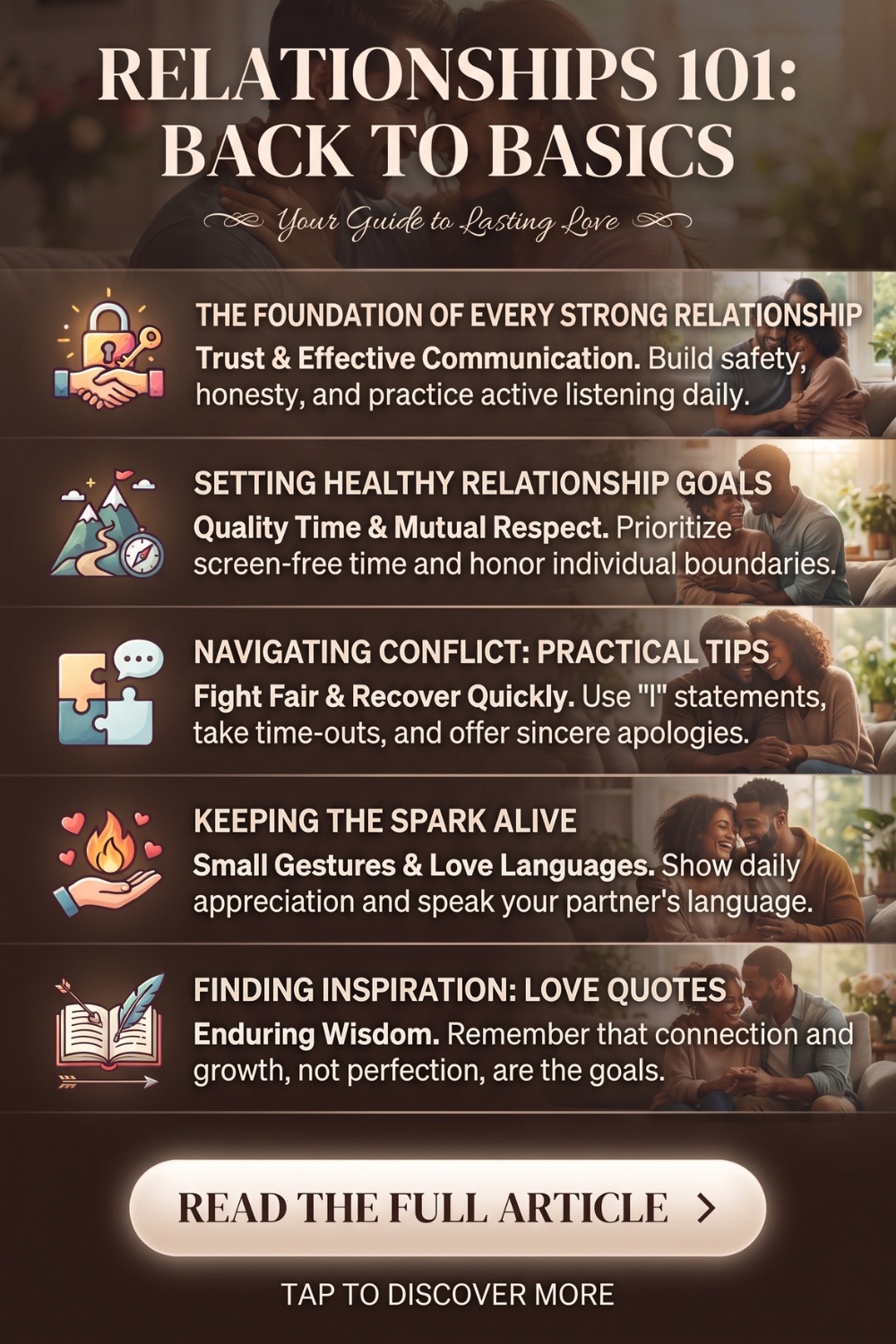

Building a lasting, healthy partnership doesn’t happen by accident. In a world full of complex dating rules and fleeting social media trends, the best relationship advice often comes down to mastering the absolute basics. Whether you are navigating the exciting early days of a new romance or looking to reignite the spark in a decades-long marriage, understanding the foundational pillars of love and connection is your ultimate key to success.
So, what makes a relationship truly thrive? It isn’t just about grand romantic gestures or picture-perfect moments. It is about how you communicate on a Tuesday evening, how you navigate disagreements without breaking each other down, and how you consistently show up for one another.
In this comprehensive guide, we are going deep into the core of what makes love last. You will learn actionable relationship tips, discover how to set healthy relationship goals, and uncover timeless love advice that will help you and your partner build an unshakeable bond.
Let’s get back to basics.
1. The Foundation of Every Strong Relationship
Before you can focus on advanced relationship goals, you need a rock-solid foundation. Think of your relationship like a house. If the foundation is cracked, the walls will eventually crumble, no matter how beautifully decorated the rooms are inside. The two main pillars of this foundation are trust and communication.
Trust, Honesty, and Transparency
Trust is the currency of love. Without it, you are constantly operating from a place of anxiety and doubt. Good relationship advice always starts here: build a safe space where both partners feel comfortable being completely honest, even when the truth is uncomfortable.
-
Keep Your Promises: Reliability builds trust. If you say you will do something—whether it’s paying a bill or being home by a certain time—do it.
-
Avoid Secrecy: Privacy is healthy; secrecy is not. You don’t need to share passwords to everything, but you should never feel like you are actively hiding parts of your life from your partner.
-
Assume Positive Intent: When your partner makes a mistake, assume they didn’t do it to hurt you intentionally. Giving them the benefit of the doubt goes a long way.
The Art of Effective Communication
We hear it all the time: “communication is key.” But what does that actually mean? Effective communication isn’t just about talking; it is about how you talk and, more importantly, how you listen.
-
Active Listening: This means listening to understand, not just listening to reply. Put your phone away, make eye contact, and validate their feelings. You can say something like, “I understand why that made you feel frustrated.”
-
Use “I” Statements: Instead of saying, “You always ignore me when I talk,” reframe it as, “I feel unheard when I’m speaking and you are looking at your phone.” This reduces defensiveness and opens up productive dialogue.
2. Setting Healthy Relationship Goals
If you want your partnership to grow, you need to know where it’s going. Relationship goals shouldn’t just be about aesthetic photos you share online; they should be concrete intentions you set together to improve your shared life.
Prioritizing Quality Time Over Quantity
Living under the same roof or sitting on the same couch while scrolling through separate phones does not count as quality time. One of the best relationship tips you can implement today is carving out intentional, uninterrupted time for each other.
-
Implement a Weekly Date Night: It doesn’t have to be expensive. Cooking dinner together, going for a walk, or playing a board game can be incredibly intimate.
-
The 15-Minute Rule: Spend the first 15 minutes after you reunite at the end of the day just talking and reconnecting, completely screen-free.
Establishing Mutual Respect and Boundaries
Healthy relationships require boundaries. Boundaries are not walls to keep your partner out; they are guidelines that teach your partner how to love you best.
-
Respecting Individuality: You are two whole people coming together, not two halves making a whole. Encourage each other to pursue individual hobbies, friendships, and passions.
-
Emotional Boundaries: Understand that you are not responsible for “fixing” every negative emotion your partner has, nor are they responsible for fixing yours. You are there to support, not to act as a therapist.
3. Navigating Conflict: Practical Relationship Tips
Conflict is inevitable. In fact, couples who say they never fight are usually avoiding difficult conversations. The goal isn’t to eliminate arguments; the goal is to fight fair and recover quickly.
Avoiding the Toxic Blame Game
When tensions rise, it is incredibly easy to start pointing fingers. However, shifting the dynamic from “Me vs. You” to “Us vs. The Problem” transforms the way you handle disagreements.
-
Take a Time-Out: If the argument is getting too heated and you feel your heart racing, it is okay to pause. Say, “I love you, but I need 20 minutes to cool down before we continue this.”
-
Stay on Topic: Avoid bringing up past mistakes. Deal with the current issue at hand without throwing the kitchen sink at your partner.
The Anatomy of a Sincere Apology
A simple “I’m sorry you feel that way” doesn’t cut it—that is a non-apology. Sincere apologies repair emotional ruptures and require vulnerability.
-
Acknowledge the specific action: “I am sorry that I snapped at you this morning.”
-
Acknowledge the impact: “I know it made you feel unappreciated and started your day on a bad note.”
-
Offer a solution: “Next time I am feeling stressed, I will communicate that instead of taking it out on you.”
4. Keeping the Spark Alive
When the initial honeymoon phase fades, maintaining the romance requires intentional effort. The best love advice emphasizes that love is an action, a daily choice you make.
Small Gestures Matter Most
Grand vacations and expensive jewelry are wonderful, but the bedrock of romance is found in everyday micro-moments. It’s the small, consistent acts of kindness that truly scream, “I love you.”
-
Making their coffee in the morning exactly how they like it.
-
Sending a random text in the middle of the work day just to say you are thinking of them.
-
Doing a chore you know they absolutely hate.
Speak Their Love Language
Dr. Gary Chapman’s concept of the five love languages is foundational relationship advice for a reason. People give and receive love differently:
-
Words of Affirmation
-
Acts of Service
-
Receiving Gifts
-
Quality Time
-
Physical Touch
If your partner’s love language is Acts of Service, writing them romantic love quotes won’t resonate as deeply as taking the trash out and washing the dishes will. Learn how they feel loved, and speak that language consistently.
5. Finding Inspiration: Love Quotes to Live By
Sometimes, we need a little external inspiration to remind us of the beauty of commitment. Sharing love quotes with your partner can be a sweet way to express feelings you might struggle to put into words yourself.
“A great marriage is not when the ‘perfect couple’ comes together. It is when an imperfect couple learns to enjoy their differences.” – Dave Meurer
“Love is not about staring at each other, but staring off in the same direction.” – Antoine de Saint-Exupéry
Keep these sentiments in mind as you navigate the ups and downs of your relationship. They serve as gentle reminders that perfection isn’t the goal; connection and growth are.
Frequently Asked Questions (FAQs)
What is the most important relationship advice for new couples?
The most crucial relationship advice for new couples is to establish open, honest communication early on. Don’t pretend to be someone you aren’t just to impress them. Set your boundaries, discuss your core values, and make sure your fundamental life goals align.
How can we rebuild trust after it has been broken?
Rebuilding trust takes time, extreme transparency, and consistent behavior. The partner who broke the trust must be willing to answer questions, validate the other person’s pain, and show through daily actions that they are reliable. It is a slow process, but with mutual dedication or the help of a couples therapist, it is possible.
What are realistic relationship goals?
Realistic relationship goals focus on process rather than perfection. Examples include: committing to one screen-free evening a week, learning to disagree without yelling, supporting each other’s career ambitions, and maintaining financial transparency.
How do we keep our relationship from getting boring?
Routine is comforting, but a rut is dangerous. To keep things fresh, inject novelty into your lives. Try new activities together, take a class, explore a new city, or simply change up your standard weekend routine. Shared new experiences release dopamine, which closely mimics the feeling of falling in love.
Conclusion
At the end of the day, the best relationship advice is simple in theory but requires dedication in practice. It is about choosing your partner every single day, even when it is difficult. By focusing on the basics—transparent communication, unwavering trust, mutual respect, and intentional quality time—you can build a dynamic, loving partnership that stands the test of time.
Remember, there is no such thing as a perfect relationship, only two imperfect people who refuse to give up on each other. Take these relationship tips, apply them to your daily life, and watch your bond flourish.
If you loved this guide and are looking for more lifestyle inspiration, be sure to pin this article to your Pinterest boards or share it with someone who could use a little extra love today!